Showing posts with label mummified arm. Show all posts

Wednesday, November 5, 2014

The Antietam Arm on Display


     If you’ve been following my blog for a while, you may have seen my previous posts about the mummified arm in the National Museum of Civil War Medicine’s collection.  It is a mummified right hand and forearm which was found on the Antietam Battlefield after the battle.  It is also clearly not amputated, but was traumatically separated, probably by a projectile.  We’ve learned quite a bit about the arm in the past two years, so we can finally share the Antietam Arm’s story with our visitors.


     It’s actually pretty interesting to follow how we discovered more about the arm.  We started with the history which accompanied with arm when it was donated.  You can read that story here.    


     We had quite a few questions about this story and about the arm, so we had some tests run on it at the Smithsonian’s National Museum of Natural History.  It was a fascinating visit that you can read about here.  


     One of the most common questions I get about the arm is whether it belonged to a Union or Confederate soldier.  It seems that when the arm was displayed at another museum several years ago, some people speculated that it was Confederate because of its “nice manicure!”  I wanted a more scientific basis for a determination of his origin though!


Though some may have thought this was a neat manicure, there are not actually any fingernails left on the arm.  The nail beds are still so clear that they give the impression of fingernails. 


     While the arm was being examined and tested, I did a little more research into the story about the doctor.  It’s a pretty interesting story in itself that you can read here.  


     However, I also noted that there was an issue with the dates in the story.  Dr. Gaines was supposedly given this arm about 6-7 months after the Battle of Antietam.  That would be sometime in the spring of 1863.  Dr. Gaines was not practicing in the area until 1866.  It may be that the arm was first given to his father-in-law, Dr. Smith, and then passed to him after they went into practice together, but we have no proof of that.  This is one of several problems with the arm’s original story.


     It was the test results which gave us the most information about the arm.  It was examined using stereozoom microscopy, CT scan imagery, digital radiography, and chemical and isotopic testing.  We’d originally been told that the arm likely came from a young male of about 19 years, so we knew he was probably a teenager.  However, it was determined that he was actually only about 16 years old.  Though this would have been rather young for a Civil War soldier, we do know that there were underage boys who lied about their ages and enlisted.  


     Bone measurements yielded the information that he was slight of build, and was only about 5’ 2” tall.  The discovery of two small arm hairs provided the information that he was Caucasian and probably had brown hair.  Dirt on the ventral (lower) portion of the arm showed that the arm had been in contact with the ground at some point, but the relative absence of dirt on the dorsal side suggested that the arm had not been completely buried.  This part does seem consistent with the story provided to us.


A digital radiograph of the arm shows that none of the bones are missing or broken.  There is no evidence of trauma other than the arm being separated at the elbow.


     Next, a small fragment of tissue was analyzed for the presence of any salts, chemicals, or toxic metals.  We were all eager to discover what chemicals had been used to preserve the arm.  I was especially interested, as this information would affect how I handled and stored the arm.  It was quite surprising to learn that there was no chemical evidence of any salts in the arm.   That ruled out the part of the story about the arm being put into a brine solution.  There were also no traces of arsenic, mercury, or lead in the arm.  This is another contradiction to the story; the arm was never put into any sort of solution to preserve it.  It dried out and mummified naturally.


     So, you might ask now if it’s even possible for a severed arm to mummify naturally in the conditions after the Battle of Antietam.  According to the report we received from the NMNH, natural mummification occurs when the body tissues are desiccated through dehydration.  Basically, dry environmental conditions help to promote mummification.  The time required for natural mummification varies depending on a number of factors, but can be well advanced by the end of just a few weeks.  Given this information, we wanted to check the weather conditions in the area after the battle.  Fortunately, this information was reported in the book, “Sounding the Shallows: A Confederate Companion for the Maryland Campaign of 1862" by Joseph Harsh. The weather conditions in this area were fairly warm and dry immediately following the battle.  The temperature ranged from 44 – 79 degrees F and there were only two incidents of precipitation recorded for the month of September, both of which were less than a quarter of an inch.  So the conditions in the area could have been right for natural mummification. 


The arm’s position gives us some information as well.  For one thing, the positions of the hand and arm are not consistent with standard burial practices.  The skin folds and contours indicate the arm was positioned with its ventral surface (forearm and palm) down for at least several weeks.


      The next big question was the origin of the arm’s owner.  Was he local or did he come from somewhere else?  If he was a soldier, was he Union or Confederate?  Isotope analysis was performed on another small sample of tissue.  Basically, this test indicates the diet and source of water of the individual, which can point to a general area of origin, but not a single state.  The results showed that he most likely came from the Pennsylvania / New York / Ohio region, with a smaller possibility of the mountainous Appalachians of Maryland and Virginia.  He had a mostly wheat-based diet, which was more common in the northern U.S.  A bone phosphate oxygen reading also helped to place his “meteoric water” reading in this area.  


     So, we had the mummified arm of a northern 16-year-old boy, which had been traumatically separated from him, but which had dried out naturally.  We also had a story which was mostly debunked.  Where do you go from there?


Other local stories exist about this arm, though of course none can be proven.  The stories do seem to have some intriguing similarities though.  According to several sources, the arm was found either on a stone wall or on a stony outcropping on the Antietam Battlefield.  So the battlefield is a common theme to the stories, along with the arm being found above-ground.  The Burnside Bridge (Library of Congress image) is cited as the place of discovery in several of the versions.  In addition, some versions of the story have the name of the town doctor who owned the arm as a Dr. Fahrney.  There was a Dr. Daniel Fahrney in Hagerstown, Maryland in the late 19th century, so that is a possibility.  That is a subject which will require more research.


     So, what is the conclusion here?  Though we’ve gained a lot more information about the arm, we’re also left with more questions about it.  We can’t prove that it belonged to a Civil War soldier, but the possibility isn’t disproven either.  We do know that it represents an injury which was typical on a Civil War battlefield, and we can display it as such.  It can bring a more human element of the story of Civil War medicine to our visitors.  It is one thing to read or hear a story about the wounds suffered and the lives lost on the battlefields.  It is quite another to see actual evidence of it.  We also know that this arm belonged to an unidentified teenaged boy, and we can honor his memory, and his possible sacrifice at the Battle of Antietam, by sharing as much of his story as we know.   
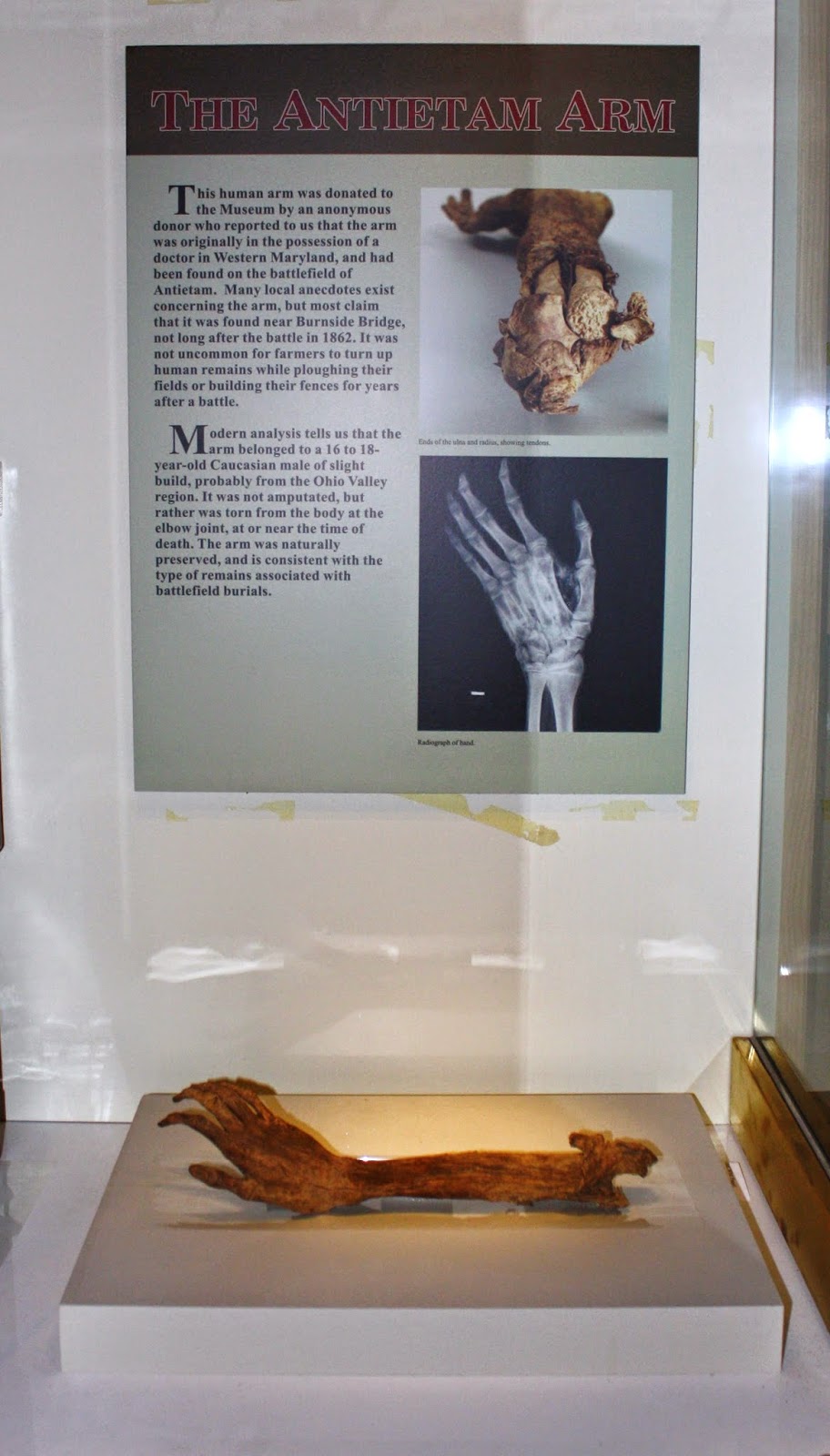

The Antietam Arm is now on display in the Field Hospital gallery of the NMCWM.


     You can view a video clip of the arm on display at the NMCWM here.     


Photos courtesy of the National Museum of Civil War Medicine, except where otherwise noted.


Thursday, October 11, 2012

Update on the Mummified Arm

     Sometimes working with museum artifacts involves being a bit of a detective.  I don’t always get the full history of the artifacts when we acquire them, so then some research is in order.

     You may recall there was a mummified arm found on the Antietam Battlefield, which was donated to my museum back in January.  [The first post about it is 
here.]  Everyone was eager to learn more about it!


If you visited the Antietam Battlefield Museum before it closed in 2004 you could have seen the arm displayed in a pine box with a tag which read, “Human Arm Found on the Antietam Battlefield.”


     Part of the research on the arm involved taking the arm to the National Museum of Natural History to be tested.  [See that post 
here.]  Though we’d hoped that the testing would be completed in time to display the arm this fall, there are still some tests to perform on it.  We have gotten some information about it though, so I thought I’d post an update for everyone who has been inquiring about it!

     The arm has had X-ray and CT scans to determine if there was any hidden damage or broken bones.  A carbon isotope test will also be performed to possibly determine the diet of the individual and thus the area he came from.  There has also been some discussion of attempting a DNA test, but that decision has been put off until some other tests are completed.  In addition, an X-ray diffraction test was performed to determine the presence of metals and chemicals used to preserve the arm.  This was especially critical information for me as the caretaker of the arm since, depending on the method used to preserve it, there was the potential for the arm to contain some hazardous substances.  Not only do I have to protect myself and any other people who may need to handle the arm, but I also need to use this information to protect the other artifacts it could be exhibited with or stored near.


This damage to the palm showing exposed portions of bones and tendons was not hidden from view! This area probably was a wound.


This radiograph shows that there were no fractures or broken bones. The scientists from the NMNH determined that growth and development stages are consistent with a male aged about 16 years. Though we’d already been told it probably was a young individual, he is younger than we initially thought. It’s rather sobering to consider just how young he was, but then we do know that many boys lied about their age in order to enlist.


     Another surprising find was that the X-ray diffraction results showed no evidence of intentional preservation using any sort of chemicals (no salts, mercury, arsenic, or lead). The mummification appears natural, which is not consistent with the story we got claiming it had been preserved in a brine solution and also some sort of embalming solution.  Clearly I need to do some research on the arm’s story as well! 


This view shows some dirt present on the bone’s surface. Considering it was reported to have been discovered in a plowed field, this is not surprising.


        Though I am still working on verifying (or sometimes debunking) various parts of the story, I have found out more about the Boonsboro doctor identified simply as “Dr. Gaines” whom the donor named as having possessed the arm at one point.  Even without the addition of a mummified arm, it’s an interesting story!

     Dr. John Mutius Gaines was born in Culpeper County, Virginia in 1837 and had a medical practice in Alexandria, Virginia before the Civil War.  When the war started he joined the Confederate Medical Corps as an assistant surgeon with the 8th Virginia Infantry.  He was at the Battle of Antietam but was left behind (as a prisoner of war) to care for the wounded soldiers.  During this time, he worked with a local physician, Dr. Otho Josiah Smith.  He apparently also made the acquaintance of Dr. Smith’s daughter Helen while he was there.  However, after six weeks Dr. Gaines was exchanged and returned to the Confederate army.

     When the war ended though, instead of returning to his home in Virginia, Dr. Gaines went back to Boonsboro, Maryland and married Helen Smith.  He evidently remembered their six weeks together well!  They lived in Boonsboro with her father, and Dr. Gaines and Dr. Smith worked together until Dr. Smith’s death.  Dr. Gaines remained in practice in Boonsboro until his retirement.  After his death his son found the arm, just wrapped in a piece of cloth, in the attic of the doctor’s old house.  From there it was passed on to other people, but I will have to save those stories for a future post. 

     So, though there is more research to be done, we have learned more about the arm.  Some of what we’ve learned raises more questions, but I look forward to discovering more of the arm’s real history!


Photos courtesy of the National Museum of Civil War Medicine

Thursday, May 3, 2012

Learning More About the Mummified Arm


     Last Thursday I took a field trip of sorts, to the National Museum of Natural History in Washington D.C.  Forensic anthropologists Doug Owsley and Kari Bruwelheide from the NMNH very graciously offered to do some testing on our museum’s mummified arm.  I was very excited to make the trip, because it has been several years since I’ve visited the NMNH and also because I’m eager to learn more about the arm. 

I packed the arm in an acid-free box, with plenty of ethafoam and acid-free tissue to protect it and to prevent it from shifting in the box during the trip. I also tied the lid onto the box to prevent the arm from falling out. It was raining that day, so I also took along a plastic bag to cover the box if necessary. Fortunately, the rain held off until I got into the museum.


     While waiting near the museum’s entrance to meet Kari, one of the museum’s visitors glanced at the box I was holding and asked if I’d brought donuts for everyone.  I wonder what his reaction would have been if I’d shown him what was really inside the box?!


The National Museum of Natural History building. As you can see by all the buses parked in front, it was a very busy day for them. And no, I wasn’t carrying the arm down the National Mall! I actually took this shot after we left the museum.


     Kari escorted me up to her lab and we spent a few minutes examining the arm.  She confirmed that it came from a young person.  I gave her the history we had for it, and promised to forward any additional information I could find.  She answered a few questions I had about the arm, and told me about a few of the tests they might be able to do on it.  At the very least, it is destined for an X-ray and a CT scan.  There are other tests which may be done which could tell us what chemicals were used to preserve the arm, and even possibly in what part of the country its owner lived.  I’m sure that after we receive all the test results I will have another blog post for you!

Kari and I discussing the arm.


     Kari offered me a tour of her lab, which I was very happy to accept!  It was fascinating.  They have bones which were discovered at the Jamestown Settlement – these are 400 year old bones which still have stories to "tell"!  They also have remains from criminal cases.  I have to admit that seeing the one that was obviously of a small child was sobering.  Still, it is amazing to see the amount of information they can obtain from these bones.

Here’s the lab - my favorite part of the trip!


     Next, it was recommended that I view the Written in Bone: Forensic Files of the 17th Century Chesapeake exhibit there at the museum.  It mainly it focuses on remains found at Jamestown, Virginia and St. Mary’s City, Maryland, and what was learned about the colonists lives. 


The image of the man at the entrance to the exhibit changes from a colonist to a modern man as you walk past it.   I tried to capture the effect by getting a shot in which he appears to be wearing half of each outfit.
That handsome fellow in the red shirt standing in front of the panel is my husband, who couldn’t pass up the opportunity to see the museum!


     Again, it was fascinating to see what they’d been able to learn from the bones, and to see how they were able to make these discoveries.  If you’re in the area, it is well worth the time to visit this exhibit!


I'm always looking at exhibits and displays at other museums to get ideas. I really liked the way they displayed the skeletons. The display looks clean and simple - there aren't complicated mounts involved to keep the bones in place, yet they are still easily visible from every side. I thought it had a lot of visual interest and impact. 


     Testing on the mummified arm may take a few months, so I will have to wait patiently for the results.  In the meantime, I’ll be looking into some options for displaying it.  Since it is associated with the Battle of Antieam, we hope to have it on display by this September, in time for the 150th anniversary of the battle.  I'm looking forward to having more of its "story" to share when we display it.
   

Thursday, February 2, 2012

Doesn’t Every Museum Need a Mummy?


     The museum received a very interesting donation last week – the mummified forearm of a Civil War soldier!  I always ask for as much history as the donor can furnish for donated artifacts, and this fellow has quite a story!

This is how the arm arrived at the museum.  It was transported inside a wooden display case.  You can see that the arm fell off the supports while in transit.


     The arm was discovered on the Antietam Battlefield about three weeks after the battle, by a farmer who was plowing his field.  The farmer thought it would make a good souvenir, so he picked it up, took it home, and placed it in a container of brine solution.  Six months later he reportedly changed his mind about wanting to keep it.  I do wonder if perhaps his wife put her foot down and told him to “Get that thing out of my house!”  He gave it to the town’s doctor, who then put the arm in a formaldehyde solution.  So, after being subjected to the sun in the farm field, and then to the brine and formaldehyde soaks, the arm is pretty well preserved.
     After the doctor’s death, the arm was found in his attic, now simply wrapped in a piece of cloth.  There is a gap in the history here, but by the early 1960s the arm belonged to the owner of a small museum on the Battlefield.  It was displayed there for many years in a back room, and was billed as “The Arm of the Unknown Soldier.”  That museum eventually closed and the arm’s ownership passed to other people.  Fortunately, its previous owner decided to donate it to the NMCWM. 


Tom and Kyle were as eager to get a closer look at it as I was!


     It was also reported that the arm was once examined by a pathologist who stated that it had belonged to a 19-year-old male.  Unfortunately, that’s the only piece of identification we have for its original owner.  It is apparent though that the arm was blown off, not amputated.  I would imagine that the soldier did not survive.  It is a rather sobering thought, and one that I keep very much in mind when I am handling the arm.

Here you can clearly see that the arm was not amputated.

     When the arm was delivered, I was concerned to see that it was housed in a pine box, and that the interior of the glass cover showed signs of mildew in some spots.  The first order of business was to remove it from the case and rehouse it in something more suitable.  A polystyrene box with a lid was obtained for temporary use.  The plastic will not off-gas harmful compounds as pine wood can, and it provides protection from water damage as well.  The box was lined with polyethylene foam and acid-free tissue paper to further protect the arm.  I added some desiccant packets to the container as well, to keep the relative humidity lower which should help prevent the growth of mold or mildew. 

     Another factor to consider is that the arm itself may still contain harmful materials.  The “formaldehyde” used by the doctor was not the same compound we know today.  It probably contained arsenic or mercury, which were used in embalming at the time.  Until we can have it tested, it will not be handled without latex or nitrile gloves!   


     Eventually the arm will be put on display.  I’m sure that crafting a suitable display case for it will be the topic of a future post!


Photos courtesy of the National Museum of Civil War Medicine