Showing posts with label insects. Show all posts

Thursday, July 10, 2014

Getting Away From It All?


     I have been sort of on vacation this past week.  I didn’t go on a big trip, I just took a little time off from work to get some projects done at home.  I did find some time to have fun though, as I visited a few local spots.  Too many times the local attractions get put on the list to visit later, and then “later” never happens!  So, one afternoon we took the short drive over to Jefferson, Maryland to tour the Distillery Lane Ciderworks.  I wasn’t expecting to be reminded of work there, but I was definitely surprised at the connections I found.


I should have known better.  Apples and cider were definitely around during the Civil War, so that was the first connection.

     The Distillery Lane Ciderworks has a self-guided tour through the orchard and farm.  It was a beautiful day to walk and take in the scenery.  Afterwards you can taste some of their ciders, but let’s take a look at our walk through the orchard first.


The farmhouse has a Civil War connection as well!  It was used at the Quartermaster's house and held weapons for the Union troops which camped at a nearby creek.  This property was chosen because it was just out of range of the Confederate cannons in the mountains at Crampton's Gap. 


And you know if the house was used in the Civil War, the barn was used as well!  This foundation is all that remains of the farm's bank barn.  It is believed to have been used as a field hospital.  Hmm, it’s starting to sound a lot like the Pry house and barn!


     Partway through the orchard, I read a sign with a familiar term - Integrated Pest Management.  It’s a concept used at most museums to prevent infestations of pests which can damage the artifacts.  You can see a previous post I wrote about dealing with insects in the museum here.  It turns out that many of the methods used at the orchard are very similar to what I use at the museum. 


This “sticky apple” traps insects, and is used to monitor for the types of pests found in the orchard.  I have similar sticky traps throughout the museum, though they don't look like apples!
  

This is a pheromone trap, which lures a specific type of insect to it.  This one wasn’t marked for which type of insect it lures, but at the museum traps similar to this one are typically used for moths.
 
     They utilized a couple of different methods too.


We don’t have much need for scarecrows at the main museum, though I suppose we could put one in the garden out at the Pry House.


The bat house on this silo counts as pest control too, since bats eat insects.  I don’t think this is something I should try at the museum though!

     My family and I enjoyed our tour of the orchard, as well as the chance to sample the ciders made there.  I’m glad we didn’t keep this trip on our “later” list!


Thursday, October 27, 2011

Creepy Crawlies

     Since it’s almost Halloween I thought I’d do a post about a more “creepy” subject, insects.
     One of the less exciting aspects of my job is monitoring for insects in order to detect and prevent insect infestations.  Monitoring is done by placing sticky traps in various locations and recording the number and kinds of insects which are found on them.  

  
This is a hospital exhibit at the NMCWM.  Displayed in the back
 is a hospital flag.  On the left is a hospital gown and on the right is a hospital
steward's frock coat.  But, can you spot the insect monitor in the exhibit? 


It's probably easier to see it in this view.  The insect monitor (sticky trap)
 is in an inconspicuous spot on the floor.  You may also notice another type of monitor
on the side wall.  That one keeps track of the temperature and relative humidity in the
 exhibit case.  That's a topic for another post though!

  
     My very first duty here at the museum was dealing with a moth infestation.  My first view of my new office included several moths clinging to the ceiling and the trim of the door.  This is NOT a sight that any collection manager wants to see, much less their first day on the job!  I immediately called the exterminator and put out some moth pheromone traps.  I didn’t shun the low-tech options either.  My new coworkers got used to seeing me patrolling the floor armed with a flyswatter!  Eventually the little winged pests were  eradicated, and everyone was relieved.


The culprit in this instance was Tineola bisselliella, the common clothes moth.


     It turned out that the moths (eggs) had been brought in on a donated item of wool clothing, which was in the quarantine cabinet in my new office.  Once the offending item was discovered it was immediately removed and treated.  Luckily, there were no other cloth items in the quarantine cabinet at the time, but as a precaution the remaining items spent additional time in quarantine being monitored.  It was a good reminder of the importance of the quarantine process.  Though we did have to deal with a moth infestation in our office area, none of the moths got into the collection room or the galleries.  They could have done quite a bit of damage there!           


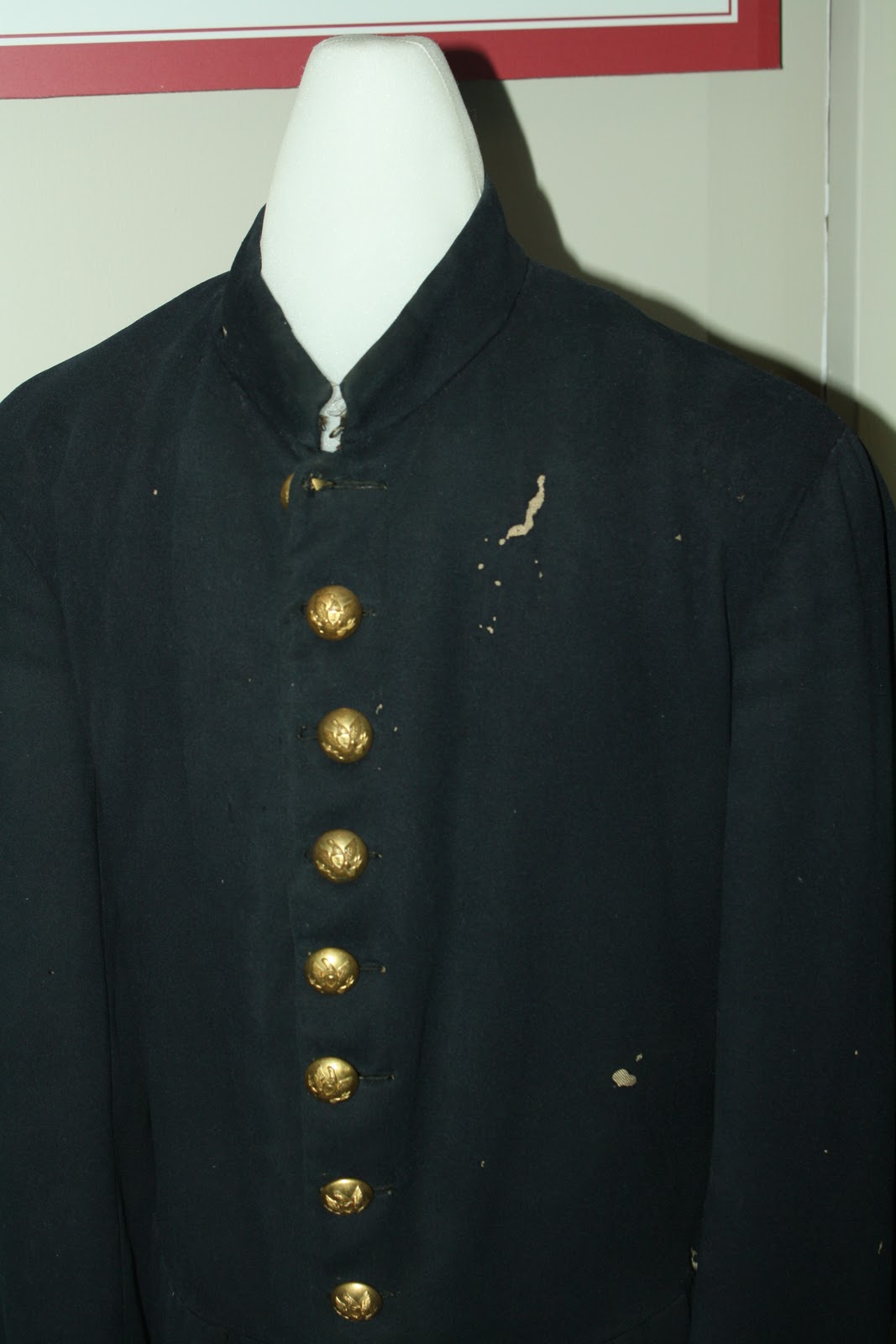
Here you can see what is probably moth damage on a wool Union Surgeon's frock coat.  I should point out that the coat came to us in this condition!


     I am happy to report that insect infestations are a rare occurrence here.  I’ll certainly do all I can to keep it that way!
    
Here's my creepy photo.  This is a close-up of an insect monitor from our office hallway, with a large cockroach on it.  Normally I can keep these traps out for a few months, but for some reason my coworkers asked that I get this one out of their sight! 

     Happy Halloween everyone, and may your day be free from insect pests!

Artifact photos courtesy of the National Museum of Civil War Medicine.