Thursday, February 21, 2013

Taking Care of the Caretaker


     Though I am the “guardian” of the artifacts at my museum, there are times I have to take care of myself as well, in order to stay in top guardian form!  Earlier this week, I was able to do that by attending the Small Museum Association conference in Ocean City, Maryland. 

 
My colleague from the Pry House, Tom Frezza, attended the conference as well. This was our view crossing the Chesapeake Bay Bridge. We saw bald eagles on the way too, but I wasn’t quick enough to get photos of them!


After a three hour drive, Tom was happy to be at the conference! 
 

     We were able to attend several workshops and roundtables on museum-related topics, to talk with vendors (and get some freebies!), and to network with other museum professionals.  There were more workshops scheduled than we could each attend, so we employed the divide and conquer method and went to different sessions.  I chose the ones which related to museum collections.  I was able to learn more about different ways to inventory a museum collection, options for displaying museum collection information online, assessing the museum building and collection area for a variety of risks, and ways for museums to become more green.  Some of the information was new to me, and some was more of a reminder of things which sometimes are forgotten in the day to day bustle.

 
The theme of the conference was “Superheroes: the extraordinary power of small museums.” You can see here that some of the workshop leaders had fun incorporating the theme into their titles! This one was actually on inventorying museum collections.

 
     The roundtable on “Building Your Museum Career” was very interesting as well.  We were divided into three groups according to our years of experience (I was in the middle group), and told to come up with advice and questions for the other two groups.  I was not surprised to learn that the younger group appreciated being listened to and mentored, but it was a good reminder for me.  I was eager to hear the main piece of advice from the more experienced group.  I was expecting something museum-based and was a little surprised when it was “Plan for your retirement!”  Though it sounds like good advice for everyone, I have to say that it was another good reminder for me.      

     We had time for a little fun too!  For the banquet on the last night, we were encouraged to come dressed in a costume which related to the theme of the conference.  There were some really creative costumes there!  One person wore a very large visor and was a “Super-visor”, another came as a magician because people at work expected her to produce items as if by magic, someone else came as “Red Tape”, and I think my favorite was the lady who dressed as a Tootsie Pop, because “You have to be a sucker to work at a museum!”  Tom & I had fun coming up with our costumes too.  He came as “Captain American History”, and I decided that I might as well dress the part of the “Guardian of the Artifacts!”

 
I tried to include many of the items I use to care for the artifacts in my costume. I made my skirt out of ethafoam (artifact padding), I wore artifact tag earrings, white gloves, and a feather duster headpiece. I carried an “acid-free shield” and of course, a light bulb changer!

 
     It was definitely worth the trip.  I learned some new things, I was able to see some museum issues in a new light, I made some new friends/contacts, and I had some good museum-related discussions.  I hope to be able to attend the next conference – perhaps even as a presenter?

 
 I have to admit that it’s easier to recharge when you have a view like this from your room!


Thursday, February 14, 2013

Please Touch the Exhibits!


     Most times, museum visitors expect to be reminded NOT to touch the items in the exhibits.  In fact, many exhibits are designed so that the items on display are protected from being handled.  Artifacts are generally displayed inside cases, or placed behind barriers.  However, there are some exhibits and displays which are meant to be hands-on for the visitors.  Of course, these displays don’t contain artifacts, but they are still effective in educating the museum’s visitors, especially the younger ones!  Let’s take a look at some of these displays in my museum.
 

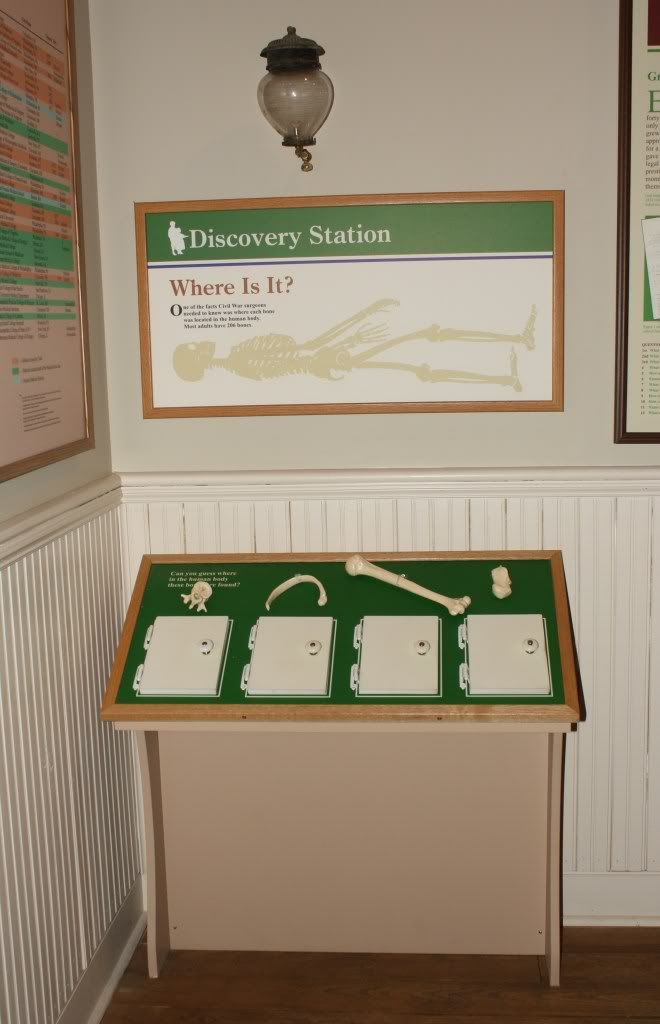
The Discovery Stations at the NMCWM were designed with school children in mind, but we notice that adults like them too! This one provides an opportunity to identify some human bones. Don’t worry, these bones are reproductions! They are attached to the display with weighted ropes so that they remain in their proper positions, but so that visitors can pick them up to get a closer look.


The answer and some additional information can be discovered by opening the door below each bone.


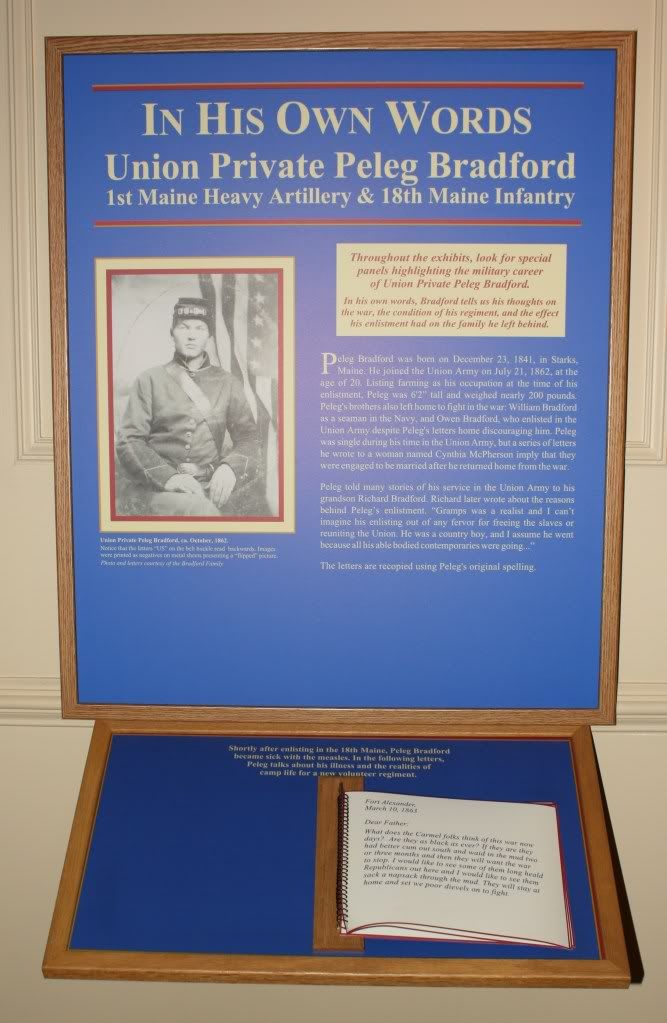
Another type of hands-on display follows a Civil War soldier through the letters he wrote home. This is just the first of several displays located in the museum which follow the war experiences of Peleg Bradford as he served, and was wounded, in the war. Visitors can flip through reproductions of the letters he wrote home and read about what happened to him.


In our Camp Life gallery, visitors can read cards which describe some of the drugs used during the Civil War. A similar display nearby has cards about some of the diseases commonly seen in the camps.


This display panel introduces visitors to several Civil War surgeons. More information about each surgeon can be seen behind the doors.


Behind this door it reads, “Surgeon William Proby Young, Jr., of Middletown, Maryland, first enlisted as a private in the 116th Virginia. After his one year enlistment ended, he appeared before the C.S. A. Army Medical Examining Board and received a commission as an assistant surgeon. Dr. Young was wounded during the Antietam Campaign of 1862, but returned to Virginia with his regiment. On June 9, 1863, he was promoted to Surgeon and transferred to hospital service.” Photo from A Band of Brothers, by Dan Hartzler.


Another Discovery Station involves information about the horses and mules used in the Civil War. Each bucket here has a question about the feeding of horses and mules on the lid, with the answer printed beneath the lid.


Do you think you know how much water a horse or mule would drink in a day?


Were you right?


It seems fitting to have a Discovery Station about children! There were more children who served in the Civil War than you might imagine.


Here is Private Robert Fryer of the 52nd New York, who was one of many underage boys who claimed to be 18 in order to enlist. Boys between the ages of 14 to 17 could sign on as musicians. Some unofficial drummer boys were as young as 9 years old. Many young soldiers, such as Private Fryer, were wounded or killed while serving with their regiments. You can see in this photo that he lost part of his hand. Photo courtesy of the National Museum of Health and Medicine.


This panel allows visitors to learn the stories of some of the wounded soldiers.


Private Lewis Martin, Co. E, 29th United States Colored Troops, had his right arm and left foot amputated as a result of wounds sustained during the Battle of Petersburg, Virginia on July 30, 1864. This photo came from the National Archives.


We certainly couldn’t leave out the Civil War nurses!


Inspired by a plea for “ladies to go to the front to nurse the sick and wounded, “ Kate Cumming left her Mobile, AL, home to serve the Confederate soldiers. Her nursing career began in the hospitals of Corinth, MS, caring for the wounded from the two-day battle of Shiloh. Officially enrolled as a hospital matron, she served with distinction with the Medical Department of the Army of Tennessee throughout Mississippi, Tennessee, and Georgia. Cumming was one of the nurses involved with Dr. Samuel Stout’s mobile hospital system during the Georgia campaign. After the war she published her journal describing her experiences with hospital life in the Confederacy. This photo is from her book, Gleanings from Southland.


Visitors can also read some of the wartime letters of another nurse, Clarissa Jones, in this display. Letters such as these give a deeper look into the feelings and experiences of the writer than an informational panel can.


     So, as you can see there are some times when it is acceptable to touch the exhibits!


Photos courtesy of the National Museum of Civil War Medicine, except where otherwise noted.

Thursday, February 7, 2013

Volunteering at a Museum


     I’ve mentioned previously that I wear many “hats” here at the museum.  In small museums it is common for staff members to take on multiple roles.  But none of us could complete our duties without the help of our dedicated group of museum volunteers!  They donate their time and expertise to tackle a wide variety of tasks both in the galleries with the visitors, and behind the scenes at the museum.  They may not get the same public recognition as some of the staff members, but they are a vital part of the museum.  Today I thought I’d show just some of the work done by our museum volunteers.
 
Sometimes the first face a visitor sees is that of a volunteer docent.
 

Volunteers lead some of the museum tours.
 

They give lectures.


They represent the museum at outreach programs.


Some even get to portray Civil War surgeons….


…or soldiers!


Volunteers help to teach our visitors things like signaling.


Sometimes teaching involves playing games! Here some volunteers play a game of croquet in front of the Pry House.


Other times the visitors can join in the games. Here a young visitor is introduced to the game of Graces.


We are very fortunate that a Civil War Santa Claus volunteers his time at our museum each Christmas!


Volunteers also work behind the scenes doing research.


As a volunteer you never know what you will be needed do – sometimes it’s directing traffic….


… or helping to reorganize the store….


….cleaning the museum….


….decorating the museum….


….doing conservation work on the artifacts (if you have the proper training!)….


….or weeding the garden!


     Volunteers do all these jobs, and many more, for no pay and usually not much recognition.  The museum could not run without them though.  I am very grateful for all that they do!
 

Photos courtesy of the National Museum of Civil War Medicine.

Thursday, January 31, 2013

The Civil War Housewife


     "I suppose you all know what a housewife is?  It is a long piece of cloth with a number of small pockets sewed along one side, and made to fold up like a pocket-book, having separate places for buttons, thread, needles, pins, &c., such as some of you may have seen your mothers or grandmothers use."  - The Reformed Presbyterian magazine. Sept. 1, 1864.

     Civil War soldiers did not have many extra items of clothing, so the clothing they wore took a lot of wear and tear.  Soldiers were often sent off to war with “housewives” or small sewing kits made by their wives, mothers, or girlfriends.  These were usually made from scraps of fabric or sometimes leather, and could be folded or rolled to pocket-size, and then fastened with ribbon, yarn, or a button.  They contained essential sewing supplies such as needles, pins, thread, buttons, a small pair of scissors, extra scraps of fabric, and possibly a thimble.  When a soldier needed to sew on a button or mend a tear, all of the necessary supplies would be at hand. 

 
In this image from the Library of Congress titled, “War views. No. 1501, Camp life, Army of the Potomac - writing to friends at home” you can clearly see a soldier in the foreground doing some mending.

 
     Since I work at a museum which focuses on Civil War medicine, we do not own any sewing kits, but we have been able to borrow two for display.  Let’s take a look at them.

 
This sewing kit can be seen in our Everyday Life display, which shows many items which the soldiers would have had with them in camp. It has a leather exterior and cloth interior. As you can see, the only remaining contents are a few pins. It is fairly typical of the sort of housewife which would have been carried by a soldier. This kit is on loan to us from the collection of Dr. Gordon Dammann.


This is a fancier sewing kit made of maroon velvet with an embossed design and metal details. It can be seen in our Nursing display and it belonged to Miss Laura R. Cotton, who was a nurse in Philadelphia. This kit is on loan to us from the collection of Mr. Chris Foard.

 
The interior of the red kit is made of leather, with a cloth flap for the pins and needles, and leather loops to hold the larger sewing tools. 


This tiny bone crochet hook was contained inside the kit. It would not have been a typical item for the housewives that the soldiers carried. 


Most kits did contain a small set of sewing scissors. This is a fairly plain set, but many times these sewing scissors were made in the shape of a stork, with the feet being shaped into the finger loops and the bird’s “beak” forming the blades.


Another item which could be found in a housewife was a thimble. Thimbles were most commonly made of metal or wood. This one is steel with an aluminum lining. It was found at the site of Clara Barton’s Missing Soldiers Office. It required some conservation work and so is not yet on display. This thimble is on loan to us from the U.S. General Services Administration.


     You’ve probably noticed that the supplies contained in a small sewing kit haven’t changed much over the years!  These kits are still fascinating though, and give us a small glimpse into the life of a Civil War soldier.

 
Photos courtesy of the National Museum of Civil War Medicine, except where otherwise noted.

Thursday, January 24, 2013

Civil War Arms of a Different Sort


     It seems appropriate after posting about amputations to post next about some of the prosthetics used by the soldiers after the amputations.  Since I’ve already posted about a prosthetic leg here, I will focus on a prosthetic arm this time.
 
Here is the only prosthetic arm in the museum’s collection. It was manufactured by Marvin Lincoln of Malden, Massachusetts. It is made of maple wood and features a lockable elbow joint, an opposable controlled thumb, a replaceable hand, and ventilation holes for the elbow stump.


     Though prosthetic limbs were around long before the Civil War, the sheer number of amputees produced by the war, coupled with the fact that the Union veterans who were amputees were provided federal government funds to purchase prosthetics, spurred many advances in the field of prosthetics.  (Confederate veterans had to request prosthetics from their home states.)  Marvin Lincoln was one of the manufacturers who supplied these artificial limbs.  An arm like the one pictured above sold for $50, which was also the amount that the government supplied for a veteran to purchase a prosthetic arm.
 

This photo from the Library of Congress shows an unidentified soldier from Company G, 147th New York Infantry Regiment, with two amputated arms. Had he not been fitted for prosthetic arms yet, or did he choose not to wear them for the photo?


This is a copy of Lincoln’s patent for his artificial arm, dated August 11, 1863, which diagrams the parts of his arm. 
 

     In the patent letter which accompanied the above diagram, Lincoln states, “To flex the arm, it is only necessary to give the upper arm a quick jerking motion, which throws up the forearm, causing the latch-spring and catch to operate as to lock it in position.  When thus bent, the arm is generally thrown across and against the breast, assuming then an easy and graceful position, and it may also be used to carry pieces of clothing or other bundles….having in this way a capability not possessed by any other arm now made…. 
I do not give to all the fingers an extended position….but that while making the two forefingers nearly straight, so that they will have the proper position to enable them to act in conjunction with the spring-thumb to hold or firmly grasp any article between them, and I give the outer fingers a hooking form….  This manner of construction enables me to impart to the hand not only a graceful and ornamental form, but to give it also a capacity to carry articles like baskets, bags, &c., by hooking them onto the fingers.”
 
   Let’s take a look at some of the details on this arm.


This view shows what remains of the leather strap which held the arm in place, the elbow joint, and the ventilation holes.


Here is a close-up of the carved hand. Unfortunately, the fingertips have all been broken. Note the details Lincoln included to make the arm look more realistic though – the nail bed on the thumb, and the flesh-colored paint on the arm. The small screw on the wrist was the mechanism used to remove the hand. It could be replaced by a hook or other implement if the wearer desired!
 

This label is located on the back of the forearm and not only identifies the maker of the arm, but also doubles as the button for the locking mechanism for the elbow.
 

     In an advertising pamphlet written by Marvin Lincoln just after the war, his artificial arms are described as being sturdy enough to handle being used in everyday life, while still being “artistic and beautiful” in appearance.  He also claimed that these arms gave their wearers, “the consciousness that what he uses to conceal his loss, and to assist him in his labors and pleasures, is no disgusting appendage, but, on the contrary, is entirely worthy to fill the ‘vacant sleeve.’”

     I tend to believe he hit the mark here!
 

You can read more about Civil War prosthetics here.
 

Photos courtesy of the National Museum of Civil War Medicine, except where otherwise noted.