Showing posts with label photography. Show all posts

Thursday, June 19, 2014

Civil War Selfies?

     People who lived during the time of the Civil War may not have had cell phones and digital cameras, but they still had photographs taken of themselves.  The most popular images were not called selfies, but carte de visites (CDVs).  These were small albumen prints which were mounted on cards measuring about 2 1/2 inches by 4 inches.  They were easy to make, inexpensive, and easy to mail.  Soldiers had CDVs taken to send back home to their families and friends, wives sent CDVs of themselves or their children, and girlfriends and fiancées sent CDVs to their sweethearts at war. 


This is a nice carte de visite of Union Surgeon Elias Marsh wearing his uniform, taken about 1865.
  
This is a copy of a famous image titled, "The Soldier's Children."  The original image was an ambrotype, and it was found in the hands of a dead Union soldier after the Battle of Gettysburg.  People were so touched by the image of the children and the story of how the picture was found that CDV copies like this one were made and distributed.  It was hoped that these images would aid in identifying the soldier and letting his family know of his fate.  Through these CDVs he was finally identified as Sgt. Amos Humiston of the 154th New York Volunteers, and the children were identified as Frank, Frederick, and Alice.
  
     It appears that things haven’t changed all that much!  Today we still use photographs as a way to remember loved ones, and to help find or identify missing persons.  So, when the Heart of the Civil War Heritage Area came up with an idea for creating opportunities for "Civil War selfies" at several of the area’s Civil War sites, we were glad to participate!  See more information about their program here.  

     We had to find a spot for our visitors to take these pictures, so we rearranged the lobby just a bit to add a mannequin of a Civil War surgeon which people could stand beside to take their selfies.  


We just had to move the Dr. Letterman welcome banner to make a place for the mannequin.  This was also determined to be a good spot since it is directly across from our admissions desk.  Our wonderful guest services staff members are there to assist in taking the photos if needed.


Kyle and I had to repurpose a mannequin from our old Recruiting Gallery scene, where he had been dressed as a civilian.  I’ll go on record here to say that it’s not easy to undress or redress a mannequin!

Kyle and Cooper put the finishing touches on the uniform of our new surgeon, who has been dubbed, Bartholomew.  You can see the metal stand at his feet which was fastened to the floor to stabilize him.  I also attached his belt to the wall, to ensure that he doesn’t fall down on the job!


Kyle got the honor of taking the first selfie with Bartholomew.


He thought there was something missing though, so a flag was hung behind the mannequin.  It looks like a good spot to take a selfie!


Our museum’s founder, Dr. Gordon Dammann, seems to think so too!


     If you get a chance to visit the National Museum of Civil War Medicine, please join in the fun!  Be sure to stop by and take a picture with our Surgeon Bartholomew, then post it and tag it #CivilWarSelfies.

Photos courtesy of the National Museum of Civil War Medicine.

Thursday, January 30, 2014

A Visit to Gettysburg College

     One of the responsibilities of my job is handling the artifact loans coming to my museum as well as those going out from my museum.  Though the loan process does create a bit of paperwork for me, the benefits of borrowing and loaning artifacts are worth it.  By borrowing and loaning artifacts from other museums, a wider range of objects can be displayed to the public.  It is an excellent opportunity for studying these artifacts and for creating beneficial partnerships with other museums.  It also doesn’t hurt to have your museum’s name in an exhibit at another museum!  


Here are two of my museum’s medical bottles that were on display at the Clara Barton National Historic Site a couple of years ago.  Though you probably can’t see it in the photo, we are credited on the label.
  
     One of the NMCWM’s current loan requests is from the Musselman Library at Gettysburg College.  I was contacted last fall by Natalie, who was a student there working on curating an exhibit on the history of medicine.  She inquired about our loan conditions, and then came down to visit the museum and to identify some artifacts which could possibly be borrowed for her exhibit.  

     Normally before another museum can borrow any artifacts I need to see a document called a facility report which provides me with detailed information about the exhibit space and the display cases.  I also need an insurance certificate from the borrowing institution, even though many artifacts couldn’t truly be replaced for any amount of money!  Then I assess the requested artifacts to ensure that they are in suitable condition for transport and display.  Finally, I pass the list along to the museum’s director for final approval.  

     Last week, I was invited to visit the Musselman Library.  It was a good opportunity to view their exhibit space in person, as well as to see their current exhibit.  Since Gettysburg is just a short drive from my museum, it was time to take a field trip!


I had to take a picture of the Lincoln bust on the main floor of the library!

After a tour of the displays in the main library, we headed up to Special Collections to see the exhibit “Slaves, Soldiers, Citizens:  African American Artifacts of the Civil War Era.”  We made it just in time, as this exhibit ended the next day!

 
The curator of the exhibit, Lauren Roedner, gave us a personal tour.  Most of the items for this exhibit are on loan to them from the collection of Mr. Angelo Scarlato.  I must say, it is quite an interesting collection!


So, this is what happens when an over-eager curator sees an artifact she wants to photograph for her blog and forgets to check her camera settings!  I know better than to use a flash, but I forgot that my camera was set to automatic - mea culpa.  If nothing else, this illustrates why using a flash to photograph any objects displayed behind glass isn’t a good idea anyway.
 

     The artifact which caught my eye is a potholder embroidered with two dancing African Americans and the words, “Any holder but a slaveholder.”  I was told that a slave crafted this potholder from a Confederate soldier's uniform, and that potholders like this one were sold in the North during the Civil War to benefit the Union Army. 


There was a nice display of items representing the U.S. Colored Troops.  Though they were only allowed to serve for the final two years of the war, the 175 regiments of free African Americans accounted for almost one tenth of the Union troops. 


And of course I spotted a medical item!  This is a document from the “Hospital for Colored Troops” at City Point, Virginia from 1864.
 

     We were all fascinated, and are grateful to Lauren, Carolyn, and Natalie for taking the time to meet with us.

     I can’t wait to see the new exhibit, and how our artifacts are interpreted.  I’m sure I’ll have another blog post for that one!


Photos courtesy of the National Museum of Civil War Medicine and Gettysburg College.

Thursday, March 14, 2013

Photographing Artifacts


     Part of keeping records on museum artifacts involves documenting them with photographs.  Photos help to provide a record of an artifact’s condition, as well as a means of identification.  So, a good curator or collection manager needs a basic knowledge of photography.  Photography has been sort of a hobby of mine since high school, plus I was fortunate enough to have once had an intern who was a photography student.  So, while I’m not a professional photographer, I can at least get some decent artifact photos!
 
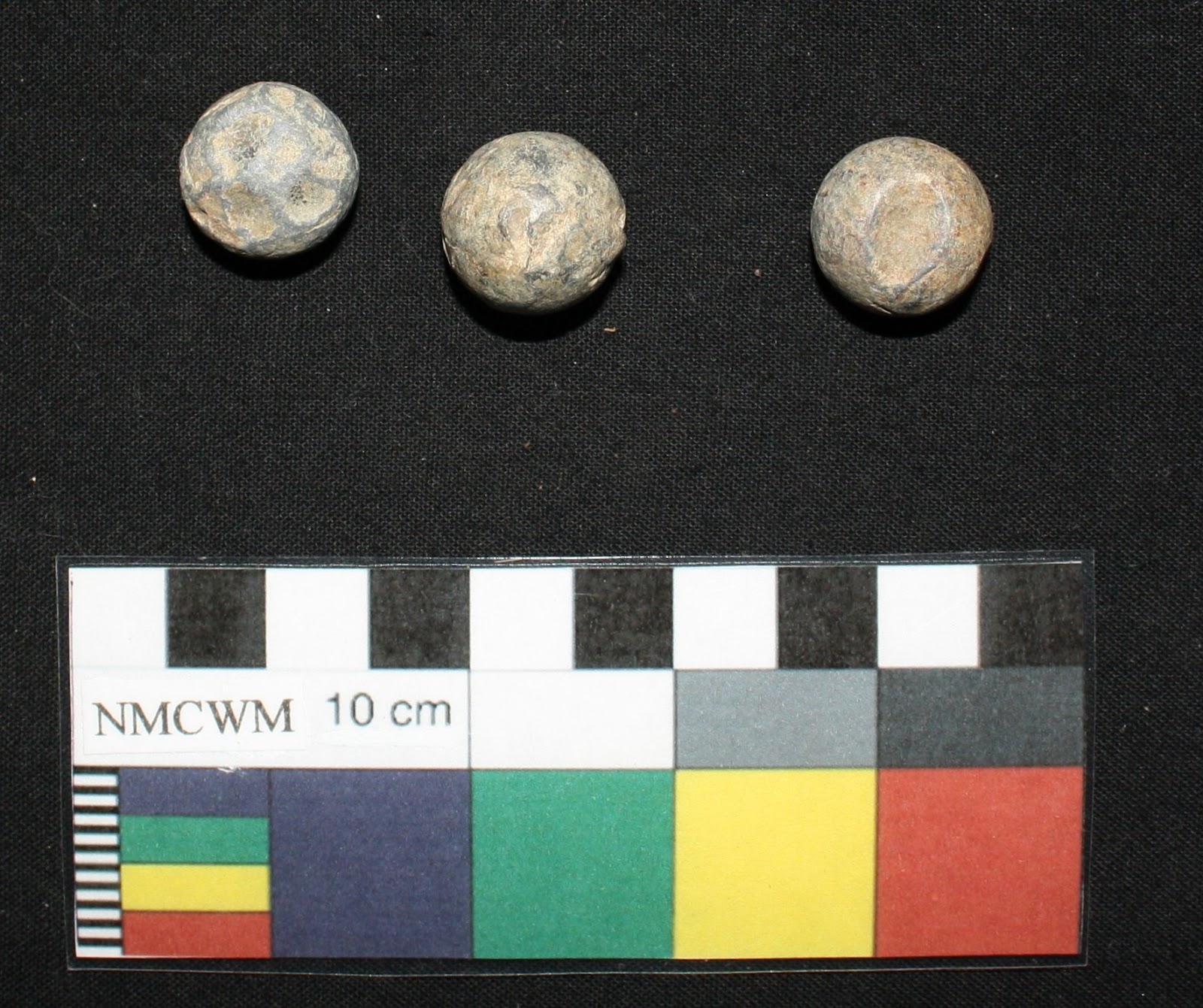
Here is a fairly typical artifact photo from my museum’s data base. It shows three musket balls against a black background, with a photographic reference scale. The scale helps to show the artifact’s size and color. 
The background is a black cloth. Paper can be used as well, as long as it is acid-free to protect the artifact.
 

I prefer to use a black background in most of my photos. Here it provides a nice contrast to this light-colored Morning Report.
 

Glass artifacts, especially clear glass ones, can be tricky to photograph! They tend to either blend into the background, or to reflect too much light which obscures the details. You can see in this shot of a glass eye cup that there is some reflection, but that the details (including the small chip in the glass) are still visible. I just won’t tell you how many shots it took me to get this one!
 

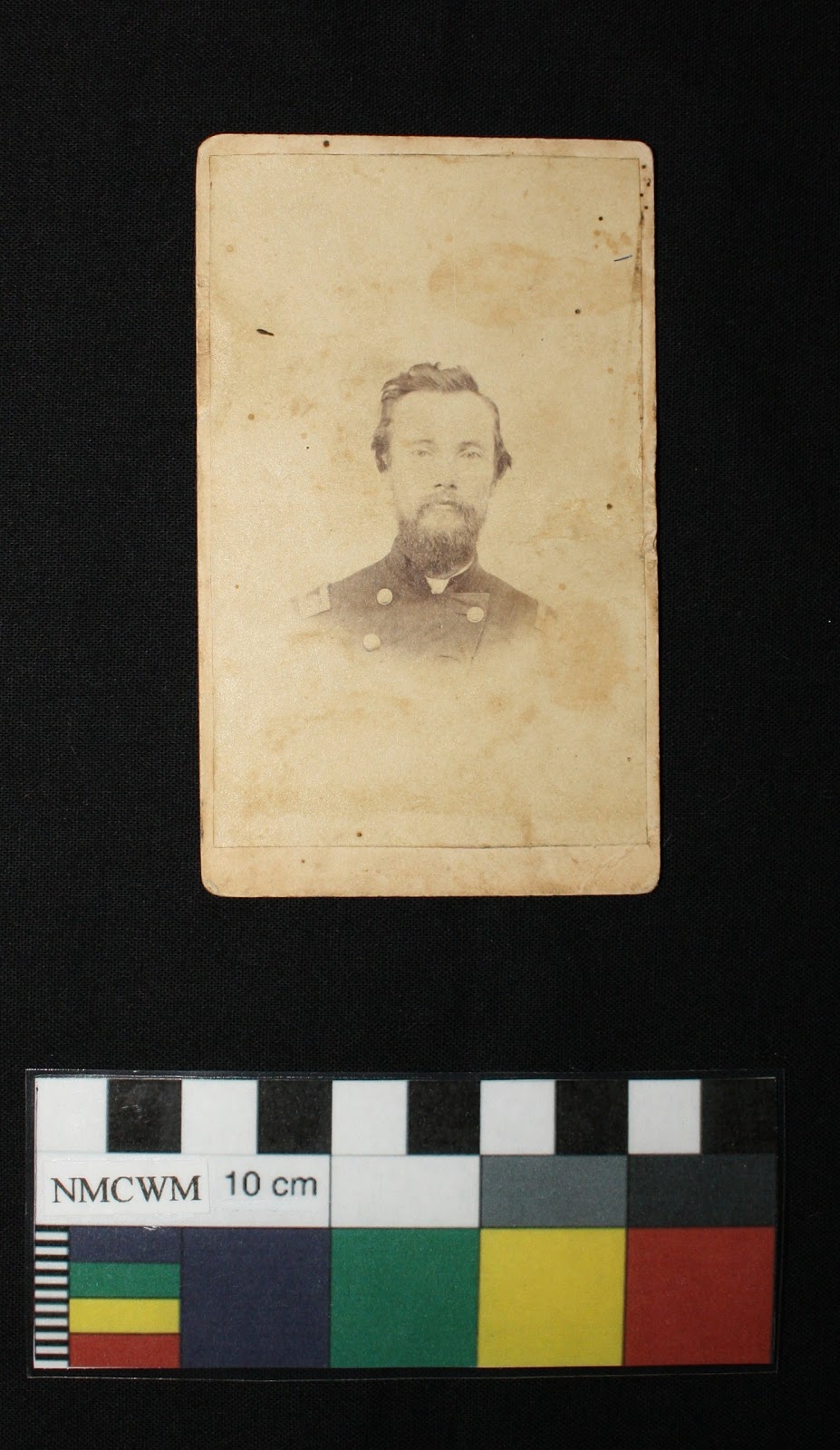
Sometimes I need to use different colored backgrounds. The black case for this portrait would have disappeared against a black background. These are supposed to be documentary photos and not “artsy” ones, so it’s best to stay with neutral colors like this gray. 
 

White can be a good background color as well. These Civil War field glasses show up well against this background.
 

I have to get more creative with the larger artifacts. I didn’t have a background cloth large enough for this flag, so I used something else I had on hand – acid-free white tissue paper.
 

     Sometimes though, I do have to leave the photographs to the professionals.  The NMCWM was recently contacted by National Geographic about getting photos of a few of our artifacts for an article they will be doing on Civil War medicine.  They sent one of their photographers to take the photos, but of course I was there to handle the artifacts.


Here’s the National Geographic photographer setting up for the photo shoot. I have to admit, that’s quite a camera! At 80 megapixels it makes my 10 megapixel museum camera look pretty puny.


 She had quite a bit of equipment to set up before she could photograph any of the artifacts.
 

My job of positioning the artifact was pretty simple by comparison!
 

I can’t wait to see how these shots look when they are published!


 Photos courtesy of the National Museum of Civil War Medicine.

Thursday, December 20, 2012

Portrait of a Civil War Surgeon


     Part of my job here at the National Museum of Civil War Medicine involves helping to tell the stories of the men and women who were involved with medical care in the Civil War.  Sometimes that is accomplished using their personal belongings or their medical instruments and supplies.  These things can certainly give insight into aspects of their lives or the medical techniques and technology of the time, but it’s not quite the same as being able to see the face associated with the objects.  I think it is far more compelling to be able to show that these were real people in the stories that we tell.  So, today I thought I would share the story and the image of one Civil War Surgeon. 
 
 
Here is a carte de visite, or CDV, of Surgeon Orange B. Ormsby in uniform, which was probably taken in 1863 or 1864. A CDV is a type of small photograph, usually an albumen print mounted onto a thicker paper, which was patented by French photographer André Adolphe Eugène Disdéri in 1854. They were inexpensive and easy to mass produce, so they were quite popular during the Civil War. Soldiers had them made to send home to their families or sweethearts, and those back on the home front had them made to send to the soldiers.  
 

     At the start of the Civil War, Orange B. Ormsby was a young physician in Greenville, Illinois.  On June 25, 1861, at the age of 25, he enlisted as a Private in the 22nd IL Infantry, Company E.  His enlistment papers describe him as being 5’ 10” tall, with blue eyes, light hair, and a fair complexion.  In August of that same year he transferred to the 18th IL Infantry, Company S and was commissioned as an Assistant Surgeon.  His claim to fame was that during the Siege of Corinth, he was working behind Confederate lines and assisted in saving the life of General Richard Oglesby, who was wounded in the chest and back.  After the war General Oglesby went on to serve three terms as the Governor of Illinois, and also served as a U.S. Senator.  The town of Oglesby, IL, is named for him. 
 
 
An image of General Richard Oglesby from the National Archives and Records Administration.
 
 
     By 1863, Orange B. Ormsby had enlisted as a Surgeon in the 45th IL Infantry, Company S, also known as the “Washburn Lead Mine Regiment.”  The 45th IL was assigned to the Army of the Tennessee, and during his time with them Ormsby would have been in battles in Mississippi, including the Vicksburg Campaign.  In fact, there are monuments to the 45th IL Infantry in Vicksburg. 

     On October 29, 1864, Ormsby was discharged for disability (lumbago and rheumatism) and went home to his wife and family in Illinois.  He received an Army pension starting when he was age 55 and died on June 13, 1899 at the age of 63.  Another interesting note is that his youngest son, Oscar Burton Ormsby, followed in his father’s footsteps by attending medical school and serving in the medical corps in World War I.
 
 
Here you can see the back of the CDV. It is marked on the back “Surgeon, O.B. Ormsby 45th ILL” in pencil. In the middle of the back is printed “A. Braisted, Photographer, Freeport, IL.” It is signed in ink at the bottom “Yours Truly, O.B. Ormsby, Surg. 45thIll. Infy.”
 

     Surgeon Ormsby’s CDV was donated to the NMCWM by one of his descendants.  He shared the story with me of searching for Ormsby’s grave:  I visited Murphysboro, Illinois in 2004 and found his grave.  An invisible string led me to it as I had no prior indication where it was but was led (by accident?) directly to it.  I went to the cemetery which was quite large and stopped at a random site, got out of the car to survey the area and found I was inadvertently located next to his plot.  The hair on the back of my neck was standing at attention!  Perhaps Orange’s spirit was helping me.  I don’t know but it makes a good story. 

     Though the CDV image is somewhat faded, we still wanted to display it.  In this case, the best option was to digitize it.  The digitized image and a brief biography of Orange B. Ormsby are currently a part of the NMCWM’s video display, “Faces of Civil War Medicine.”  This way Surgeon Ormsby’s image and his story can be shared with the public, while the original CDV image can be better preserved for the future.  I hope Orange’s story can be preserved this way as well! 


Photos courtesy of the National Museum of Civil War Medicine, except where otherwise noted.
 
*Note – I will be taking a short break for the Christmas holiday, but I look forward to sharing more blog posts with you in 2013.  Happy Holidays everyone!