Showing posts with label doctors. Show all posts

Thursday, May 22, 2014

The History of a Surgical Kit

     Since I work at the National Museum of Civil War Medicine, I’m sure you’d naturally expect that the artifacts in the museum’s collection relate to Civil War medicine.  That is generally true, but there are a few items which may not appear to relate at first glance.  Today let’s take a look at a surgical kit which fits this category.


This kit is a four-tiered general operating set, ca. 1875, manufactured by J. H. Gemrig of Philadelphia.  Though the kit and surgical instruments are similar to those used during the Civil War, the date places it as a post-war kit.  So why would it be included in our collection?


     The kit belonged to Gerard F. Mason, M.D., of Charles Town, Virginia (later to become West Virginia).  By all accounts, he was a respected and prosperous physician in the town.  His oldest son, William L. Mason, was a member of Baylor’s Company, 12th Cavalry, C.S.A.  However, Gerard Mason did not serve in the military.  His story is linked to someone whose name might be familiar to you though.  


Portrait of John Brown in 1859.  On October 16, 1859, John Brown led a raid on the United States Armory and Arsenal at Harper’s Ferry, Virginia.  His goal was to abolish slavery through armed insurrections.  He was captured though, then put on trial, convicted, and sentenced to death.  Image from Wikipedia.org.
  
     During his trial, the wounded Brown declared that he was too ill to attend court.  His claim was suspected by some to be a ruse to delay his trial.  Millard K. Bushong wrote in A History of Jefferson County, West Virginia, that “Brown was examined by Dr. Gerard F. Mason, a reputable Charles Town physician, who pronounced him perfectly able to stand trial.”  The trial was not postponed, but Brown requested to be carried from jail into court on a cot and to give his testimony while lying on a couch.  However, it is interesting to note that when court was adjourned that day, he walked back to his jail cell!  

     So, Dr. Mason’s distinction comes from being the physician who examined John Brown and declared him fit to stand trial.  Records also show that Dr. Mason was one of the physicians who examined John Brown’s body after his execution.  His surgical kit, though manufactured after the Civil War, still has a connection to Civil War medicine, as well as a story to be told.   


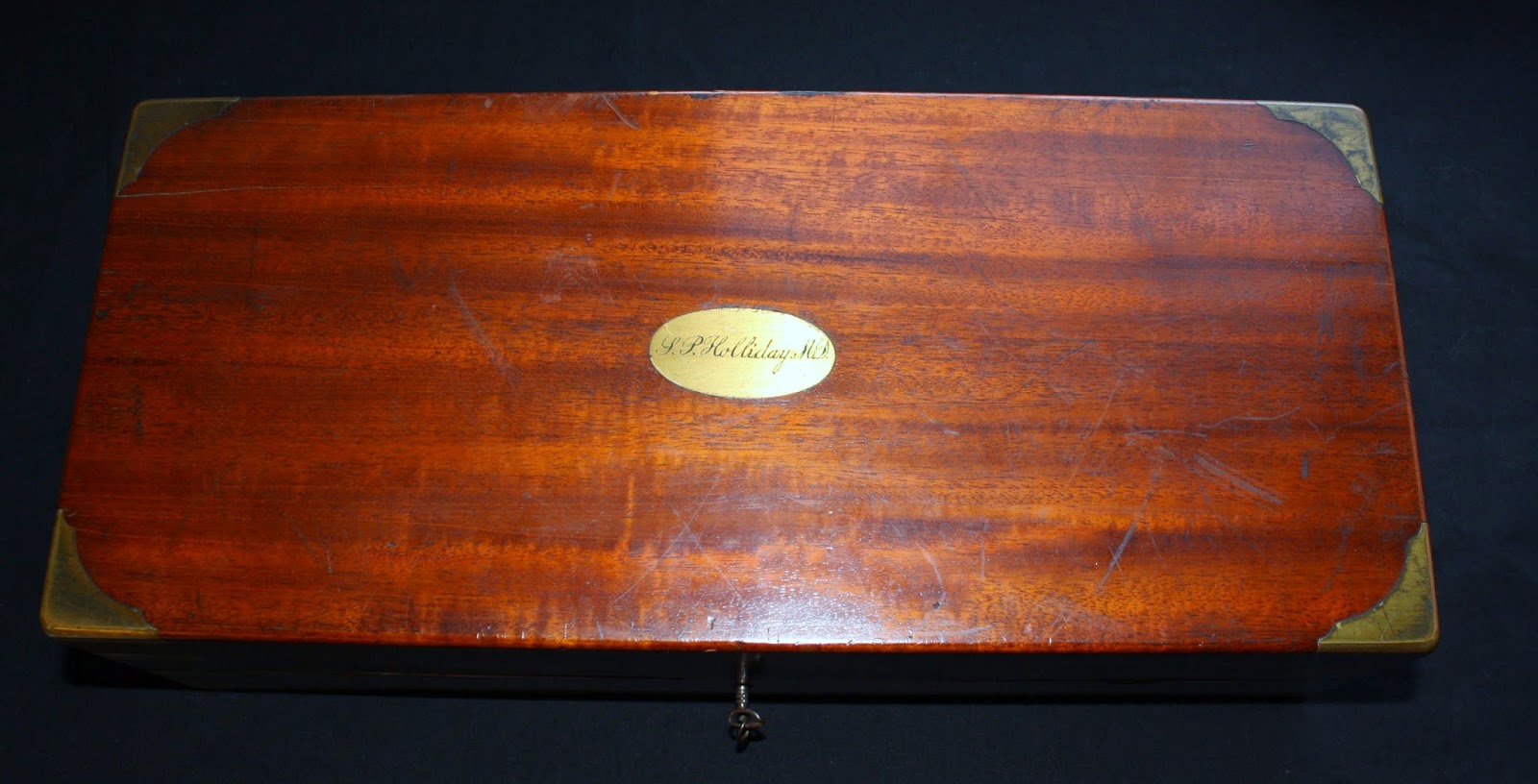
You can see that the kit has the name “Holliday” engraved on the lid.  It originally belonged to a Dr. Samuel Holliday in Winchester, Virginia who died without children.  His sister, Margaret, ended up with kit.  She also ended up becoming Mrs. Gerard Mason, which is how he came to own this kit!  It continued to be handed down to family members until it was donated to the NMCWM by a descendant of Dr. Mason’s.

     And that’s one of the best parts of my job - you never know what sorts of stories you will discover!


Photos courtesy of the National Museum of Civil War Medicine, except where otherwise noted.

Thursday, April 17, 2014

Pull Up a Chair!

     If you’ve ever been camping, you know that it’s helpful to bring along a camp chair.  Surgeons in the Civil War discovered the same thing!


In this Library of Congress photo taken in 1863, and titled, “Bealeton, Va. Noncommissioned officers' mess of Co. D, 93d New York Infantry”  you can see that the men are seated on folding camp chairs.


This Civil War folding camp chair belonged to Assistant Surgeon Sheffield Greene of the 15th New York Cavalry.  It is a small chair, standing just over 31” high when unfolded.  It folds flat when not in use, and the back wood support behind the seat also functions as a carrying handle. 

     Let’s find out a little more about the owner of this chair.  Sheffield Wells Greene was born in Hopkinton, Rhode Island, in 1814.  He attended Geneva Medical College in 1845 which made him a bit older than most medical students.  He began practicing medicine after his graduation in 1846.  On December 26, 1863, he enlisted with Company D, 15th New York Cavalry Regiment.  I was not able to find an image of him, but the vital statistics on his enlistment papers list him as being a 44 year old physician, 5’ 10” tall, with gray eyes, black hair, and a dark complexion.  There is a discrepancy here regarding his age, as according to the birth date listed in his family records he would have actually been 49 years old when he enlisted.  It’s possible he was afraid of being rejected and so lied about his age.  It’s also possible the age listed on his enlistment papers is a clerical error.  In either case, it is interesting to note that he was older than the average Civil War recruit.   

     Though there is no record of Assistant Surgeon Greene being wounded in battle, he was sent to the Geisboro hospital in Washington D.C. in April 1864.  A month later he returned to camp, but it was recorded that he was still unable to perform his regular duties.  There is one notation in the Company Muster Roll which indicates he was “Absent on detached service” and assigned as a nurse at the Camp Stoneman Hospital starting in July 1864.  It was a common practice at the time to assign some of the nearly-recovered patients to nursing duties.  
  
     An excerpt from a later letter to the Pension Office uncovers the reason for his hospitalization:  “…during the forepart of the months of April 1864 while on return march from Burlington Gap, West Virginia [we] dismounted.  And in consequence of exposure at Springfield, West Virginia, and being under orders to continue the march of the mountains on the way to Pleasant Valley state of Maryland was turned over by Order for Rupture to the camp Hospital at that place and remained there about one week, and from there to Washington D.C.   My comrade Rev. David Rittenhouse who had entire charge of me and had the said order of the evidence of this disability that the Diarrhea followed in train, from which I never recovered, and that I was treated for Rupture in the Hospital by the proper treatment of Suspencery Bandages and for the Diarrhea secundum artem and that I was in the fourth ward Hospital at Camp Stoneman D.C. and also at Judiciary Square Hospital D.C. December 1864 and remained there until in January 1865 and that said Rupture was brought upon me as alleged in my original applications by carrying heavy Cavalry Baggage on the return march from West Virginia.”

     In other words, he developed a hernia, and chronic diarrhea  - a prevalent complaint for Civil War soldiers!  A hospital record from his stay at Judiciary Square General Hospital in December 1864 lists his age as 50 (which supports his enlistment age of 49).  He was diagnosed there with hydrocele and was granted a furlough on December 16, 1864.  After reporting back for duty in January 1865, he was commissioned into Field & Staff New York 147th Infantry.  Despite his medical issues, it appears that he continued to serve for as long as he was able.  He was mustered out on June 7, 1865, and he returned home to New York to practice medicine.  


There are no manufacturer’s marks on the chair, but it does have the initials ‘S.W.G’ stenciled in black paint onto the back of the chair.  Perhaps they were put there by the doctor himself? 


     In 1882, Dr. Greene applied for a pension, but a series of letters between him and the pension office indicate that there was some question as to whether his disability was sustained during his service or was a preexisting condition.  Ultimately it was argued that his recruitment papers stated he had been examined by a physician and found to be in good health when he enlisted.  It took four years, but his request was finally approved.  He died in 1899 at the age of 85, and is buried in the Richburg Cemetery in Wirt, NY.

     A bit more about Dr. Greene is found in the book, Allegany County and Its People: a centennial memorial history of Allegany County, New York, by John Stearns Minard and Georgia Drew Merrill.  The conclusion of the summary of his life tells more about his character, “The doctor for 40 years has given arduous and unspared labors for the relief of human suffering, and can look back along an honest and diligent life with a consciousness of doing well all duties falling to his lot.”


Photos courtesy of the National Museum of Civil War Medicine, except where otherwise noted.

Thursday, September 26, 2013

A Diary and a Love Poem

     We get all sorts of books pertaining to Civil War medicine donated to the museum, but I think my favorites are the diaries.  They go beyond the medical facts and figures and give glimpses into the lives of the medical caregivers of the time.  Today I thought I’d give you a look at a small diary kept by an Assistant Surgeon in the Civil War.
 
 
This pocket diary is 6” high, 3 ¼” wide, and ¾” thick, which would have made it small enough carry easily.  It is covered in dark green leather, and it was printed by W.G. Perry, Manufacturing Stationer, in Philadelphia.  It covers the year 1863.
 

     This diary is on loan to the museum and is currently on display in our Camp Life gallery.  I was offered the chance to borrow it by the great-grandson of its author.  We had talked on the telephone a few times, and he was very interested in sharing this diary and a few other related artifacts, so that more people could enjoy them.  He was a very charming gentleman, and we were in the process of arranging for the delivery of the artifacts when I stopped hearing from him.  I was shocked and quite sad to learn that he had passed away.  I was very grateful when his daughter decided to honor his wishes and go forward with the loan of the artifacts.
  
A drawing of Dr. Thomas Lawton, author of the diary.
 
     The diary was written by Thomas Clark Lawton, who was an Assistant Surgeon with the 37th Massachusetts Volunteer Infantry.  Thomas Lawton was born in Hartland, CT, on February 8, 1834.  He attended Sheffield Medical School and graduated in 1859, after which he worked at the Rainsford Island Hospital in Boston, MA.  Dr. Lawton was one of the first volunteers to enlist in the 37th Massachusetts Volunteer Infantry, remaining with them from August 15, 1862 through February 23, 1864.  He was in the battles of Fredericksburg, Chancellorsville, and Gettysburg, as well as the 1863 New York draft riots.
 
In addition to the dated pages, it contains a mini-almanac in the front with charts for moon phases, eclipses, railroad distances, and postal rates, as well as an 1863 monthly calendar which lists the daily sunrise, sunset, and moonrise times.  In the back are memoranda pages and cash account pages for each month.  There is also a small pocket in the back of the diary which contains two letters of reference from Rainsford Island Hospital in Boston for Dr. Lawton, and two newspaper clippings of his obituary.
 
     The first entry in the diary is for New Year’s Day in 1863.  Dr. Lawton notes that they were camping along the Rappahannock River (Virginia), and that he was doing picket duty.  He adds that the previous New Year had been much more pleasant!  Later entries describe muddy marches, setting up tents in the rain, shortages of food, illnesses and deaths, sending requisitions for medicines which never arrived, going on furlough, and seeing President Lincoln reviewing the troops. 
     It appears that he was in Maryland as well:

Friday, July 10 – Left our camp near Boonsborough early and marched towards Hagerstown.  Heavy canons a little in advance.  Marched some 4 miles and took position on the right of the corps in line of battle.   Lay there all day and night.  Located my hospital in a nice grove in the rear.  Seven companies under the Maj.  Detailed about 10 ock at night to go on picket.  After packing up and going 2 miles it was concluded they were not needed and sent back. 

Saturday, July 11 – Lay in same position all day.  Rec’d orders to pack up and put all meds away about sundown.  After about an hour’s waiting rec’d orders for the men to go to sleep.  Went back to our old position and had a good night’s rest.  Orders to march at 4 tomorrow morning.

Sunday, July 12 – Left our position this morning and marched in the direction of Hagerstown passing through Funkstown.  Came up with reb pickets about a mile beyond.  Funkstown and Antietam Creek formed in line of battle and sent out skirmishers.  Lay in first position for about 2 hours.  Then moved to the left about a mile or so and formed again.  A very heavy shower in p.m.  Skirmishing very heavy – quiet at night when we advanced our pickets.  Several of the 2nd RI wounded.  Took a house for a hospital.  Slept in a hay loft.  Had my horse stolen at night – found her again.

     Thomas Lawton was not the only one who made entries in his diary though.  His fiancĂ©e left several short notes, poems, and drawings for him to find, as well as an entry on January 10 reminding him that it was her birthday!   Her name was Nina Vose, and seeing her additions makes me think that this diary may have been a gift from her.  Dr. Lawton makes many references in it about to writing to Nina and receiving letters from her.  While Dr. Lawton’s diary entries are mostly matter of fact, Nina’s little additions are more playful.  On one page she left him this little ditty:
“Thomas was an idle lad,
And lounged about all day. 
And though he many lessons had,
He minded naught but play.”
 
 
This sketch was left in the diary by Nina.  Its caption reads, “Your residence – Pig, Cow & well sweep - & a faithful likeness of yourself.” 
 
     I had chuckle when reading that Nina signed many of her entries “Pinkie”, and in one instance, “Naughty Pinkie.”  It seemed quite evident that these two were more than just a little fond of each other!  As difficult as it must have been for them to be apart, their story does have a happy ending.  After the war, Dr. Lawton set up a private practice in Hinsdale, MA, married Nina, and they raised four children together. 
     The last diary entry on December 30 is a poem written in the doctor’s handwriting that seems to tell it all:
“They never loved who idly say
That lover’s hearts are apt to stray.
For O, I tell thee, gentle one,
True love is changeless as the sun,
Unlike a transient flashing flame
It glows eternally the same;
‘Tis fixed in reason and the will,
And ceases not till hearts are still.”
 

Photos courtesy of the National Museum of Civil War Medicine.

Thursday, June 13, 2013

The Man Who Stopped the Civil War


     Last week I installed a new exhibit out at the Pry House Field Hospital Museum, which deals with Civil War Surgeon Elias Joseph Marsh. 
 
An image of Surgeon Marsh in his uniform, taken about 1865.  This photo is marked on the back, "Sarony & Co., New York."
 
     Dr. Marsh was born in Paterson, New Jersey in 1835.  His father, who was also named Elias Marsh and who was also a physician, died when Elias was just 13 years old.  Elias Marsh followed his father into medicine, and graduated from the College of Physicians and Surgeons in New York City in 1858.  He then moved to St. Louis, Missouri to set up his own medical practice. 

     At the start of the Civil War, Dr. Marsh immediately offered his services to the Union.  He was first appointed as a "surgeon's mate" in the Third New Jersey Volunteers.  A few months later he was appointed as an Assistant Surgeon in a Cavalry unit.  He participated in the Peninsula Campaign, and was taken prisoner at the Battle of Gaines’s Mill in 1862.  His status as a physician allowed for him to be exchanged fairly quickly though.  Afterwards, he served as the director of Armory Square Hospital in Washington DC.  By the end of the war, he was on General Philip Sheridan's staff.  During the war, Dr. Marsh earned the reputation as a fearless and courageous soldier.  Nothing could induce him to slight a duty he considered his, and he was never happier than when he was trying to alleviate the suffering of others.
 
The Marsh exhibit includes information about Surgeon Marsh, and several artifacts which belonged to him.


This display case contains his carte-de-visite, rank insignia, and a medal which was presented to him by the Veteran’s Society after the war.  It also contains a copy of his Certificate of Commission, dated August 10, 1861, which is signed by President Abraham Lincoln.  There is too much light in the room to display the original document.  The original may soon be on display in the main museum though.


Surgeon Marsh’s rank insignia – small oak leaves embroidered in metallic thread on dark blue wool patches.  In November 1864, the United States War Department allowed any officer who desired a more discreet appearance in the field to “dispense with shoulder straps” and wear the mark of their rank directly on their uniform.  Most likely Surgeon Marsh wore these as a result of this edict.


This much larger and fancier gold dress epaulet also belonged to Dr. Marsh, but it would have been part of his dress uniform.  The embroidered “MS” stands for Medical Service.  The back is covered in red velvet and is marked, “Schuyler, Hartley& Graham, Military Goods, New York.”

 
Also on display is a pocket surgical kit which belonged to Dr. Marsh.  This kit was manufactured by F.G. Otto & Sons of New York.  You can see that it is quite worn!  Normally I try to display these kits open so that the instruments are visible, but this case is too fragile for that.
 

Instead, I put the instruments out on display separately.  This folding scalpel actually has two blades, though only one is visible in this view.  The handle is made of tortoiseshell, and the small buttons on the handle are used to lock the blades into place.   
 

     Surgeon Marsh is sometimes referred to as "The Man Who Stopped the Civil War."  It seems a strange designation for a surgeon, but it was a case of being in the right place at the right time!  While Generals Grant and Lee considered the terms of surrender at Appomattox Court House, parts of the Federal and Confederate armies were still firing at each other.  General Grant turned to Assistant-Adjutant-General Thomas Weir, and asked him to see that the firing was stopped.  However, General Weir knew his horse was worn out and not fit for the task.  He asked Dr. Marsh to transmit the orders to the regimental commanders.  So, the cease-fire orders he conveyed brought an end to the shooting.
 
There were visitors waiting at the door while the exhibit was being installed.  This was the scene just moments after I left the room!
 

     It’s good to see Dr. Marsh’s service being appreciated!


Photos courtesy of the National Museum of Civil War Medicine.