Showing posts with label Missing Soldiers Office. Show all posts

Thursday, April 3, 2014

An Exhibit at the Missing Soldiers Office!

     It seems that I have been writing about the preparations to open the Clara Barton Missing Soldiers Office for quite a while now.  It takes a lot of work to open a new museum!  There has been quite a lot for us to do; especially since the space needed restoration work done before we could tackle developing exhibits for it.  However, I’m happy to report that the museum’s official opening is imminent. 

     While we wait for that, let’s take a look at what is happening there now!

The Welcome Center on the first floor of the building now has a wonderful mural called “Washington in Wartime – A Capital in Crisis.”  Tours of the Missing Soldiers Office will start here.

Next, visitors can ascend the same steps which Clara Barton used to get to her third floor boarding room and office.  It’s a bit of a climb, but is definitely worth the effort!

If you’ve seen my previous posts about the Missing Soldiers Office, this hallway is probably familiar by now!  The doors to the Missing Soldiers Office are to the left, and Clara Barton’s room is at the end of the hall to the left.

     Though the Clara Barton Missing Soldiers Office is still a work in progress, we have recently been able to put the first exhibit in the space!  “Bringing the Story of War to Our Doorsteps: Rediscovering Alexander Gardner’s Antietam Photographs,” was created as a collaboration between the NMCWM and the Frederick County Civil War Round Table, with support from Hood College of Frederick, MD.  If it looks familiar to you it is because it was first exhibited in the fall of 2012 at the Pry House Field Hospital Museum on Antietam National Battlefield.  You can read more about that exhibit here. 


The exhibit, which is located in the room used as the Missing Soldiers Office, uses photo reproductions in the same dimensions as Alexander Gardner’s original photographic images.  The images are displayed in the same manner as they were 150 years ago, complete with magnifying glasses for the visitors.

     Though none of these images are of Clara Barton, these images from the Antietam Battlefield relate to her because this was where she first served as a relief worker during a Civil War battle.  They also relate to her Missing Soldiers Office, where she identified many of the soldiers who were killed on this and other battlefields.  It is a very fitting opening exhibit for the CBMSO.


Across the hall, another room is set up to show the images in 3-D.  The original photos were shot with stereoscopic cameras, so this allows visitors to view them in the way they were originally intended.

     The CBMSO is now open just on Saturdays and Sundays from 11:00 am to 5:00 pm, and this exhibit will run through May 18th of this year.


I hope you can come out for a visit.  Marcie and Garrett are eager to show off every detail of the museum!

Photos courtesy of the National Museum of Civil War Medicine.

Thursday, January 16, 2014

More Progress on the Clara Barton Missing Soldiers Office Museum

     We’re still working hard on getting the Clara Barton Missing Soldiers Office ready to open!  The restoration work has been completed, and now we are working on finishing the welcome center, putting up the informational panels, displaying a few artifacts, and determining how the tours will proceed through the space.  So, earlier this week a group of the museum staff visited the space for a “practice tour.”  


We finally have an admissions desk – and who wouldn’t want to see Jake’s smiling face welcoming them to the museum?
Judy and Jake look on as Susan starts the tour in the Welcome Center, where visitors will first learn a little about Clara Barton and life in Washington D.C.
The architecture and various features of the building will be part of the tour as well.  On the third floor, where the Missing Soldiers Office was located, is an original bracket for a fire extinguisher.  The two holes would have held leather buckets filled with sand.
Here in Clara Barton’s Reception Room you can see the holes for the stovepipes and the lightwell windows.   
Though reproduction gas lamps are displayed in most of the rooms, one of the boarding rooms is equipped with an oil lamp.  The oil lamp would have predated the gas lamps. 
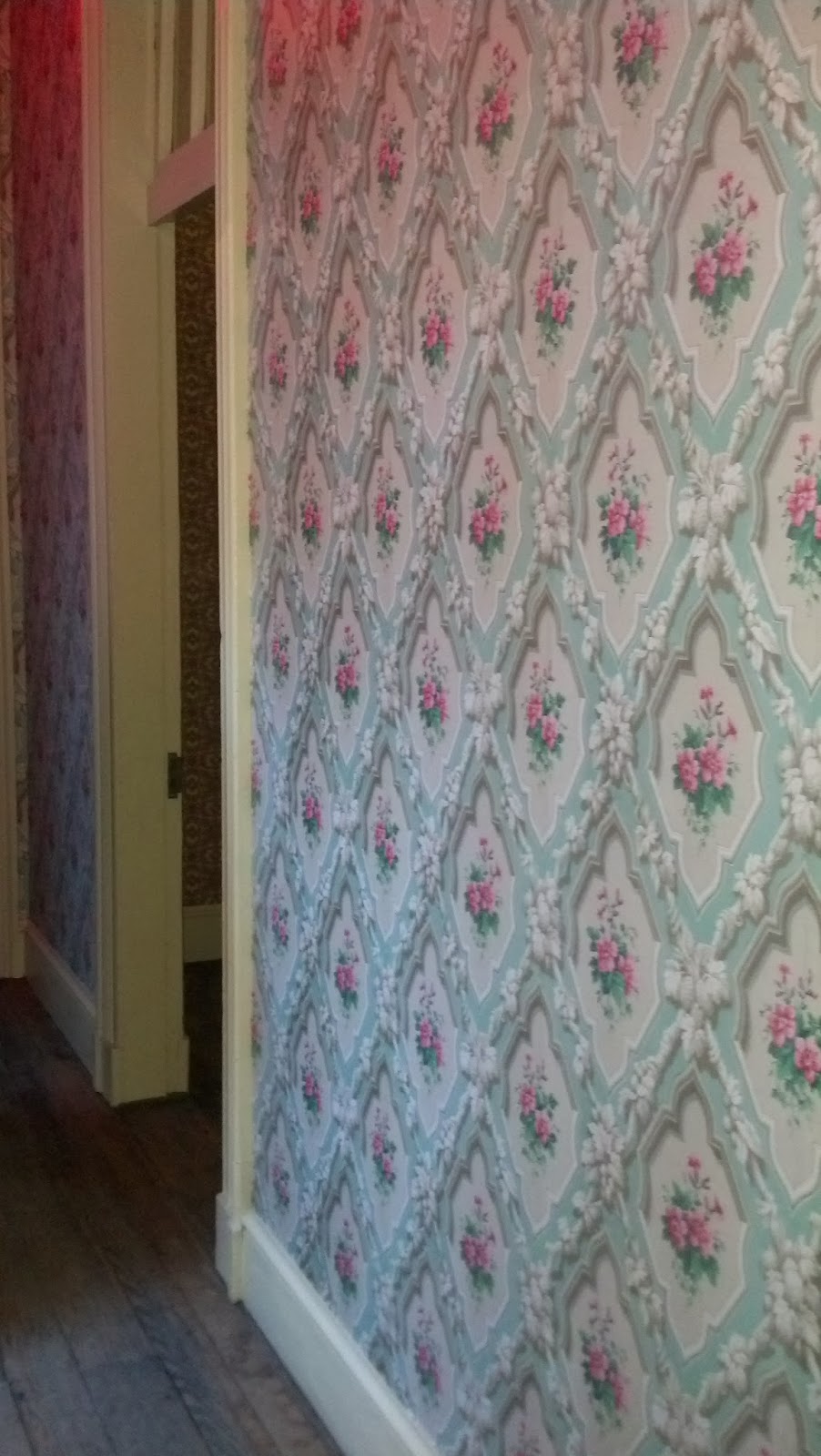
Several sections of wallpaper original to the building have been preserved behind Plexiglas.  Here in the space which housed the Missing Soldiers Office is one section which shows two of the different wallpapers that were used in the room.

     I hope you have enjoyed this little “sneak peek” into the progress toward opening Clara Barton Missing Soldiers Office!  If you missed the last update on the restoration work you can see that here.  We are anticipating the museum’s grand opening in the next few months, so you shouldn’t be kept waiting for too much longer!

Photos courtesy of the National Museum of Civil War Medicine.

Thursday, November 21, 2013

Restoration of the Missing Soldiers Office


     I spent a day in Washington D.C. this week to see the completed restoration work on the Missing Soldiers Office building.  It looks much different than it did when I first saw it over a year ago.  The interior now appears much like it did when Clara Barton lived and worked there.  This is a big step toward being able to open the Clara Barton Missing Soldiers Office Museum to the public.  Now we can focus more on the exhibits and the artifacts to be displayed in the building. 

     In the meantime, let’s take a look at the work that has been done.  You can see some of the “before” photos here.

The first floor of the building is the Welcome Center and gift shop.  Here you can see the new floor, and some of the items which will be for sale.  There will be some displays here as well.
 
 
The Missing Soldiers Office was located on the third floor of the building, so the majority of the exhibits will be there.  Visitors to the museum will be able to walk up the same staircase that Clara Barton used.
 

Several of the period wallpapers from the building were reproduced.  This is the back hallway of the building where the kitchen, dining room, and some boarding rooms were located.
 

Gas lights were reproduced for the rooms as well.  The lights in these fixtures even flicker like the real ones did!
 

Some sections of the old wallpaper were preserved.  You can see by the reflection of the window in the photo that the old wallpaper is protected by sheets of Plexiglas.
 
Here is the front hallway with more reproduction gas lights and a skylight.  The doors to the right were boarding rooms.  The rooms to the left made up the Missing Soldiers Office.  The room through the far doorway and to the left was Clara’s room.
 
Here is the door which was pictured being restored in my previous Clara Barton post (see the link above).  Room number 7 was part of the Missing Soldiers Office. 
  
Here’s a peek inside the Missing Soldiers Office.  The panel is a depiction of how the office probably looked while Clara Barton was there.  You can also see the data logger I left there in August in the bottom stovepipe hole.  I retrieved that on my visit and was able to download the environmental information from it.  This information will help to guide us in choosing the artifacts and display cases for the space.


Further down the hall is the door to Clara Barton’s room!
 
I don’t want to give away too much before the museum’s opening, but here’s a look inside Clara’s room.  The ladder you see is the same one which was used when the artifacts were discovered in the attic, so the ladder and the opening to the attic have been left here to help tell the story of the building. 

     My next update should be on the displays in the Missing Soldiers Office.  I am looking forward to sharing them with you!  In the meantime, you can see more photos and follow our progress on our website, here.

Photos courtesy of the National Museum of Civil War Medicine.

Thursday, August 29, 2013

Progress on the Missing Soldiers Office

     Just yesterday I had the opportunity to go to Washington D.C. to see some of the restoration work which has been done on the building which housed Clara Barton’s Missing Soldiers Office.  My museum has been working with the owner of the building, the General Services Administration, to open the Clara Barton’s Missing Soldiers Office Museum in this space.  There is still a lot of work to be done, but already there is visible progress!

 
Recently, a small Welcome Center was opened on the first floor of the building.  At the moment, it is open on weekdays. 


The space isn’t finished, so no artifacts can be displayed here yet.  There are some great informational panels and a video presentation on display though.
 

     The main part of the new museum will be located on the third floor of the building, where Clara Barton lived and worked.  A restoration crew is still hard at work preparing the space for visitors. 

Here’s a "before" look at the room which housed the Missing Soldiers Office.

 
Here you can see that the walls and ceiling have been restored, and the wood trim around the windows has been painted. 
 

Most of the interior doors looked like this one.
 

Here a conservator carefully removes the dirt and the top layer of finish from one of the doors.  You can see the lighter area at the bottom of the door that he has already cleaned.
 

While I was there, he uncovered the original number on the door!
 

Here’s a look at the hallway outside the Missing Soldiers Office doors, before any restoration.
 

The hallway is looking much better now, and a skylight has also been added.
 

This is Clara Barton’s living space before restoration.
 

Here is what her living space looks like now. 
 

At the moment, most of the walls are covered with white wallpaper liner.  Several of the original wallpaper patterns from these rooms have been reproduced and will be put on the walls.  There are some places where the original wallpaper is being preserved on the walls though.  These sections will be covered with Plexiglas so that they will be visible, but protected.
 

Another section being preserved shows a signature from a previous wallpaperer. It reads, “Papered by Andrew Frye, Apr. 29, 1898.”
 

It’s a bit hard to read through the liner paper, but the tradition of signing the walls before applying the wallpaper is being carried on by the current crew!
 

One reason I visited yesterday was to place this data logger in the space.  This little unit records hourly readings of the temperature and relative humidity.  This data will help me to better plan for how to exhibit the artifacts. 
 
     So, the Clara Barton’s Missing Soldiers Office Museum is closer to being finished!  There isn’t an official opening date yet, but be on the lookout for an announcement sometime this fall.

Photos courtesy of the National Museum of Civil War Medicine.

Thursday, April 25, 2013

Some Clara Barton Artifacts


A portrait of Clara Barton, Civil War nurse and founder of the American Red Cross, from the book Red Cross in Peace and War, written by Clara Barton.


     One of the advantages of letting people know about your museum projects is that some generous people will donate items for the project!  Since it was announced that the National Museum of Civil War Medicine was partnering with the General Services Administration to open the Clara Barton’s Missing Soldiers Office Museum, we have received a few donations which relate to Clara Barton.  Let’s take a look at these recent acquisitions now.

     The first one we received was a book titled, Red Cross in Peace and War, which was written by Clara Barton and published in 1899.  It contains accounts of her work after the Civil War with the Red Cross, as well as many black & white photos and illustrations of the places where she worked.
 
 
The book shows some wear but is in reasonably good condition.  Notice that Clara’s signature is reproduced on the cover!


     Next we received a photograph which included Clara Barton.
 
 
This photo is of the graduating class of the Philadelphia School of Nursing, taken in June 1903.  The woman in the dark dress in the front row is Miss Clara Barton, at age 82.  She was the commencement speaker and Honorary President for this class of nurses.


When the photo is enlarged you can actually recognize Clara Barton!


     We then received a group of three documents which pertain directly to the Missing Soldiers Office.  Two of the documents are letters concerning a soldier named Thomas Jefferson Payntar of the 4th NY Cavalry, who was declared missing in action after the Battle of Travilian Station in Virginia in July of 1864.  The letters were written after the battle by his commanding officer and one of his comrades.  His commander was able to tell Mrs. Payntar about the last time he saw Thomas, “… just before dark I saw him mount his horse and take his place in the ranks, like the good soldier he always proved himself to be.”  He speculated that Thomas had been wounded and taken prisoner, but that was all the information he was able to give her. 

     The other letter actually mentions Clara Barton’s Roll of Missing Soldiers, which she posted in newspapers in an effort to find the missing men or discover their fates.  [The letter is copied using the writer’s own grammar and spelling.]

Muncy Station, Pa., Aug. 4th/66

Mrs. Thomas J. Payntar,

     On looking over the Rolls of missing men that Clara Barton has published I came across the name of my comrad Thos. J. Payntar and feel it my duty for his sake to inform you as near as I can the place and time I last seen him.  It was at Travillian Station, Va. on the 11th of June 1864.  The Regt was ordered to fight (on foot) and every fourth man hold his own horse and three others and it fell to him to hold the horses.  I was riding by his side and gave him my horse to hold.  That was the last time I seen him.  We were over powered and forced to fall back on our Horses and when we found them they were all scattered through others.  I could see nothing of mine although I sucseeded in gettin one and made my escape.  His horse was found in the Regt the next day. 

     Thos. J. was returned as missing in action.  I thought he was taken Prisnor, but if he has not been heard of yet it is likely he was killed.  Alass did I say killed?  It makes my heart bleed when I think of the noble dead that has fallen by the hands of tratars in Rebellion.

     I think I have written all that will be of interest to you and hope you will excuse the liberty I have taken.

Respectfully,

W.H. McCowan, late Sergt. Co. E, 4 NY Cav.

P.S. Pleas answer

 
     The third document is the reply from Clara Barton which Mrs. Payntar received after sending a letter to the “Office of Correspondence with the Friends of the Missing Men of the United States Army” regarding her husband.  Due to the high volume of requests which the Office received, Clara sent out forms like the one pictured below:
 
 
This document, dated July 17, 1865, was sent to Mrs. Payntar to confirm that her letter had been received, and to let her know that her husband’s name would be placed on the Roll of Missing Soldiers.


     Clara Barton was not able to find Thomas J. Payntar, but by 1867 she had responded to over 63,000 letters and had identified the fates of about 22,000 men.  Though undoubtedly she had to report that many of the men had been killed, it had to have provided some closure for the grieving families.  Artifacts such as these will certainly help to tell the story of Clara Barton’s Missing Soldiers Office Museum when it opens!


Photos courtesy of the National Museum of Civil War Medicine.