Thursday, September 4, 2014

The Barton Trunk Bed on Display

     If you’ve been following my blog recently, you’ll probably remember that I’ve been working on putting together a display for the trunk bed of Clara Barton’s which is on loan to us from the American Red Cross.  Though it took just a bit longer than expected, it is finally out on display!  The case which housed the Clara Barton exhibit here at the NMCWM was too small for the trunk bed to be displayed open, so I had to do a little rearranging first. 
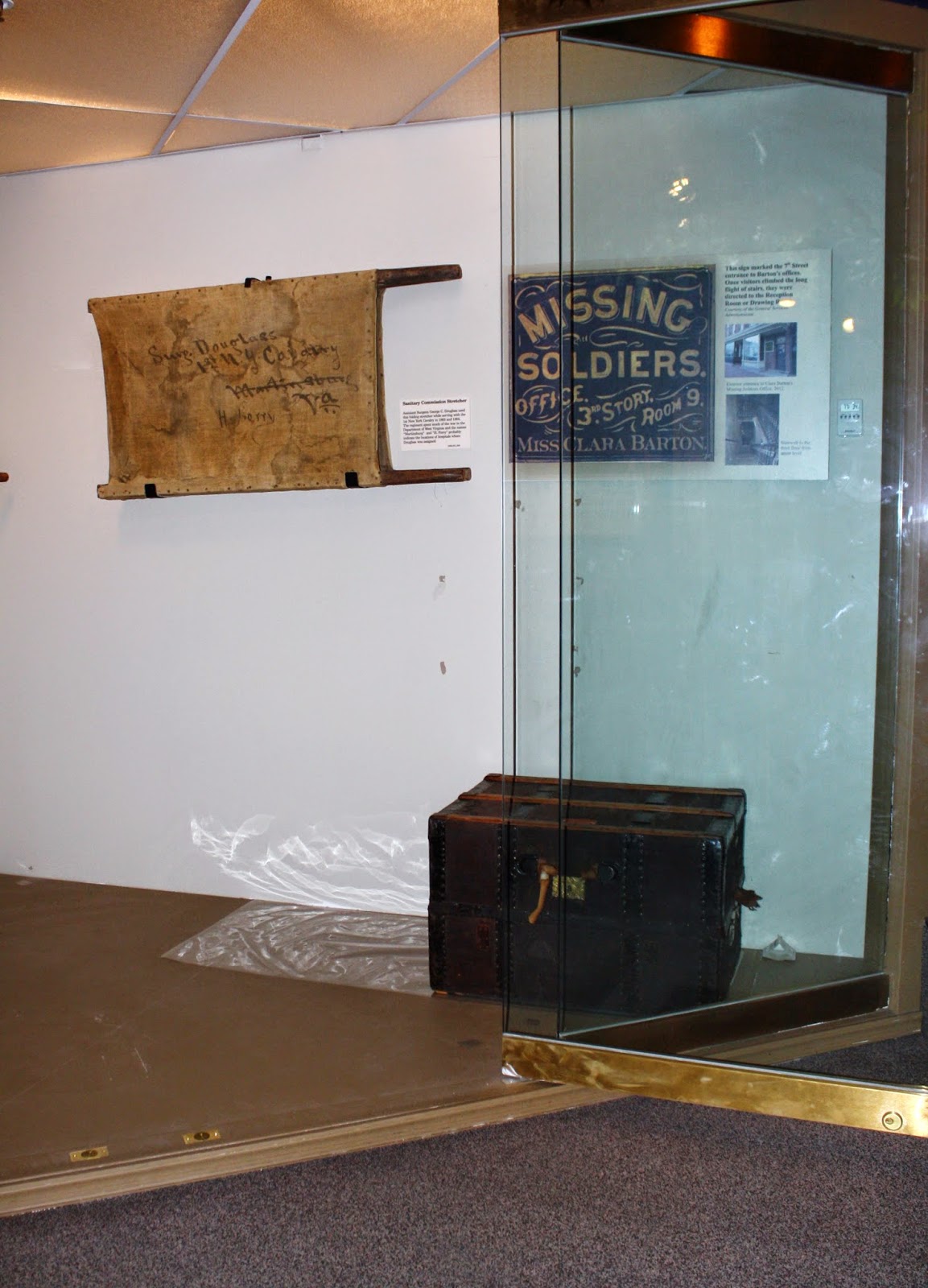

I had to switch the Barton display with our stretcher display, and put away one of the large stretchers for now.  You can see that there’s plenty of room for the trunk in this case though.  You can also see the sheet of Mylar I placed beneath the trunk to protect it.


And here is the trunk bed folded out, complete with the poles and lines to support the mosquito netting. 


     I had originally intended to display the bed with the mosquito netting around it.  However, I had concerns about how much stress that would put on the fragile fabric.  Though I could have supported the top with a layer of fabric or Mylar, the sides were more problematic.  It also would have obstructed the view of the bed somewhat.  So, I decided to display a piece of the netting draped across the end of the bed instead.


Here’s a close-up view of the mosquito netting which was found inside the trunk bed.   Though it is in great shape for 150-year-old fabric, it is still prudent to treat it gently.


The trunk bed is displayed with some of the artifacts found at Clara Barton's Missing Soldiers Office in Washington D.C., which are on loan to us from the U.S. General Services Administration.

And just so that no one is disappointed about not seeing the bed set up with the mosquito netting, here is an image of that from the Red Cross!


     If you get the chance, come by and see it in person – the display will be here for at least a year.  


Photos courtesy of the National Museum of Civil War Medicine, except where otherwise noted.

*If you missed my previous posts about Clara Barton's trunk bed, you can read Part 1 here, and Part 2 here.   


Thursday, August 28, 2014

Artifacts Online!


     I’ve been working on a big project here at the museum for the past couple of months, and I can finally share it with you.  The National Museum of Civil War Medicine’s artifact collection is now online!  I’ve been advocating for this feature for a couple of years now, so I am very pleased to see it finally available to the public.  Now anyone who wants to find out about a particular artifact at the NMCWM can simply search for it online.  This should be a great help to students, educators, re-enactors, and researchers who want information, and even images, of our artifacts.

     Basically, this is a part of the PastPerfect Museum Software artifact data base which I use to keep track of the collection.  It is some of the artifact information which has been entered by all of the museum’s curators who have worked here.  I can update the images and information, and add new artifacts as needed though, so the amount of information contained in this online data base will continue to expand. 

Go ahead and take a look at it here.
      
     You can search by category, by keywords, or even by a person’s name if you have something specific in mind.  There is also a “Random Images” button you can click to see pictures of a random group of artifacts from the collection. 


Even though I know what is in our collection, I find it interesting to see what comes up in this search! 


     I hope you have fun exploring the artifact collection of the NMCWM, and that you learn a little something in the process!

Photos courtesy of the National Museum of Civil War Medicine.

Thursday, August 21, 2014

No Mules Allowed in the Galleries!

     One of the NMCWM’s recent donations is an original plate taken from the “Atlas to Accompany the Official Records of the Union and Confederate Armies,” which is also referred to simply as the “War of the Rebellion Atlas.”  This atlas was published by the Government Printing Office in 1895, and was compiled by Captain Calvin D. Cowles of the 23rd U.S. Infantry.  It was published in 36 volumes, and contained 175 plates of maps, illustrations, and technical drawings from both Union and Confederate sources.


This particular print is titled, “Diagram Illustrating the Principle Means Used in Transporting the Sick and Wounded and Medical Supplies during the War of the Rebellion, 1861-5.”  It’s certainly something we can use at the National Museum of Civil War Medicine!

 
     It contains 39 individual illustrations of Civil War medical care and transport items, some of which we have on exhibit at the museum, including various stretchers, a U.S. Army medicine pannier, and a field medical kit.  


The Squibb medicine pannier fits well into one of our cases.


     However, many of the other items illustrated, including a hospital ship, an Autenreith medicine wagon, ambulance wagons, hospital train cars, and an Army wagon and mule team, simply wouldn’t fit into our display cases, or even our galleries.  Or would they?  Take a look at how we managed to display some of these larger items.  


Diagrams like this one of a Civil War hospital steam ship are certainly one way to show an item which would be too large to bring into the museum building….


….especially if you also have an interior plan of the item to show how the item was constructed and equipped.  You can read more about a Civil War hospital ship here. 


A real Autenreith medicine wagon wouldn’t fit in the museum.  So, we could show visitors this diagram of it….


….or we could have just the back portion of an Autenreith medicine wagon reproduced and installed on a wall.  With the addition of a Plexiglas cover over the back, we can also display some of the original medicines and supplies which were contained in the wagon.  While it isn’t an original wagon, it certainly shows how these wagons functioned.


A full-sized railroad car is certainly too large to fit into most museums,….


…..but we turned a ramp between galleries into a hospital train car, complete with some background train sounds!  You can get a closer look at our “Train Ramp” here. 


Though I’m sure everyone would love to see real mules hitched to a real Civil War army wagon….


….we can’t have animals in the galleries with the artifacts!  The horses and mules painted on this mural do still show how the wagons were moved.  In this case, it is a reproduction of an ambulance wagon, or more accurately, HALF of an ambulance wagon.  The other part of the wagon is incorporated into the mural in order to save space.


     Finding creative ways to display these over-sized items can certainly be challenging, but I think our team here at the NMCWM has done a great job!

Photos courtesy of the National Museum of Civil War Medicine.