Thursday, May 22, 2014

The History of a Surgical Kit

     Since I work at the National Museum of Civil War Medicine, I’m sure you’d naturally expect that the artifacts in the museum’s collection relate to Civil War medicine.  That is generally true, but there are a few items which may not appear to relate at first glance.  Today let’s take a look at a surgical kit which fits this category.


This kit is a four-tiered general operating set, ca. 1875, manufactured by J. H. Gemrig of Philadelphia.  Though the kit and surgical instruments are similar to those used during the Civil War, the date places it as a post-war kit.  So why would it be included in our collection?


     The kit belonged to Gerard F. Mason, M.D., of Charles Town, Virginia (later to become West Virginia).  By all accounts, he was a respected and prosperous physician in the town.  His oldest son, William L. Mason, was a member of Baylor’s Company, 12th Cavalry, C.S.A.  However, Gerard Mason did not serve in the military.  His story is linked to someone whose name might be familiar to you though.  


Portrait of John Brown in 1859.  On October 16, 1859, John Brown led a raid on the United States Armory and Arsenal at Harper’s Ferry, Virginia.  His goal was to abolish slavery through armed insurrections.  He was captured though, then put on trial, convicted, and sentenced to death.  Image from Wikipedia.org.
  
     During his trial, the wounded Brown declared that he was too ill to attend court.  His claim was suspected by some to be a ruse to delay his trial.  Millard K. Bushong wrote in A History of Jefferson County, West Virginia, that “Brown was examined by Dr. Gerard F. Mason, a reputable Charles Town physician, who pronounced him perfectly able to stand trial.”  The trial was not postponed, but Brown requested to be carried from jail into court on a cot and to give his testimony while lying on a couch.  However, it is interesting to note that when court was adjourned that day, he walked back to his jail cell!  

     So, Dr. Mason’s distinction comes from being the physician who examined John Brown and declared him fit to stand trial.  Records also show that Dr. Mason was one of the physicians who examined John Brown’s body after his execution.  His surgical kit, though manufactured after the Civil War, still has a connection to Civil War medicine, as well as a story to be told.   
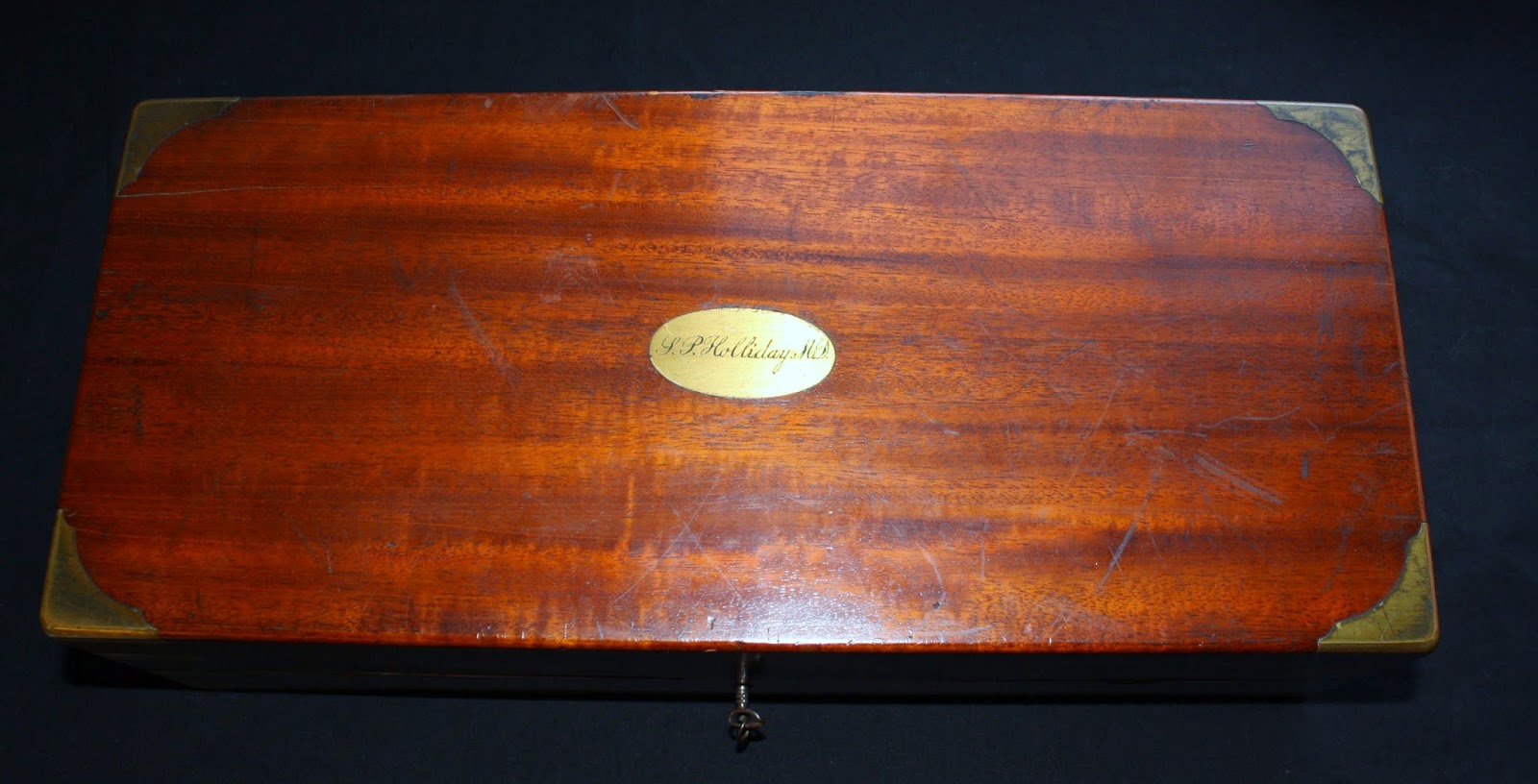

You can see that the kit has the name “Holliday” engraved on the lid.  It originally belonged to a Dr. Samuel Holliday in Winchester, Virginia who died without children.  His sister, Margaret, ended up with kit.  She also ended up becoming Mrs. Gerard Mason, which is how he came to own this kit!  It continued to be handed down to family members until it was donated to the NMCWM by a descendant of Dr. Mason’s.

     And that’s one of the best parts of my job - you never know what sorts of stories you will discover!


Photos courtesy of the National Museum of Civil War Medicine, except where otherwise noted.

Thursday, May 15, 2014

Slow to Heal

     Part of my job as the curator at the National Museum of Civil War Medicine involves handling the loans of artifacts to other institutions.  I always request photos of the artifacts on exhibit, because I like to see how other museums handle displaying these artifacts.  Sometimes though, I get to actually visit in person.  Recently I had the opportunity to see the new exhibit at the Musselman Library at Gettysburg College.  The curator of the exhibit, Natalie Sherif, had contacted me several months ago about borrowing some artifacts from the NMCWM to display.  I was eager to see how she had used them in her exhibit, “Slow to Heal:  The Evolution of Medicine from the Civil War Era to WWI.”  


I got the curator’s tour from Natalie!  In this exhibit, she explores some of the history of medicine, using artifacts, photographs, and letters.  You can read some of Natalie’s thoughts about this exhibit here.  

     There’s a lot I try to take in whenever I see a new exhibit.  I want to see the intended message of course.  I tend to get a little distracted by the actual artifacts, their mounts, their labels, and the type of lighting though.  I suppose that’s just an occupational hazard!


These medical school class notes on dysentery are particularly appropriate for the Civil War!  Notice though, that the page is a reproduction.  This helps to preserve the original, which could be damaged by being displayed in the light for too long.

Here’s a familiar sight – an amputation kit which came from my museum!  The lid has been propped up slightly here to help visitors see the kit, and to keep the hinges on the kit from being stressed from the weight of the lid.

One topic covered in the exhibit is women in the Civil War.  I was pleased to see this letter written by Clara Barton.  Hmm, perhaps I’ll be requesting a loan from Gettysburg College next!


I was particularly interested in seeing how this Civil War cacolet (chair stretcher) from my museum would be displayed.  It was a bit large for the display case, and the fabric needed to be supported to prevent it from becoming stretched or distorted.  You can see some of the padding which was used.  What you can’t see is how part of it is suspended from the shelf support by monofilaments attached to the wood.

What can I say – I’m always fascinated by items associated with prostheses!


     There’s much more to this exhibit than what I can show here.  If you’re in the Gettysburg area, check it out in the Special Collections room at the Musselman Library through August 1 of this year.  For more information call (717) 337-7002.

Thursday, May 8, 2014

What's in the Box?

     Last week I posted about my trip to North Carolina to pick up an artifact for my museum.  This week I’ll finally tell you about the artifact! 


No, this isn’t the artifact!  It was made by the artifact’s owner to protect and store it.  You can probably guess that it belonged to a Civil War soldier named Mason Myers.  Do you have any ideas about what could be in this box?  Maybe a little more information will help…. 

     Private Mason Myers was a Union soldier from Orwell, New York.  He enlisted in September of 1861 at the age of 19 years.  His enlistment papers list him as being a farmer.  He was 5’8” tall, with a light complexion, dark eyes, and light hair.  He served with the 24th New York Infantry, and later with the 76th New York Infantry.  He was wounded in action during the Battle of Bull Run in 1862 and also during the Battle of Gettysburg in 1863.  He was discharged for disability in September 1864.


This undated photo shows a uniformed Mason Myers (right) with his brother-in-law Robert Armstrong.  I can say for certain that this image was taken before he was  wounded at the Battle of Gettysburg though.    Image from the “76th NY Roster” at http://www.bpmlegal.com/76NY/roster-m.html

     By now, you probably have a good idea about what is contained in the box.  Private Myers was shot in the right leg on the first day of the Battle of Gettysburg, and his leg subsequently had to be amputated.  Afterwards, he needed a prosthetic leg.  


This is the wooden peg leg which is said to have belonged to Mason Myers.

     The U.S. government did have a program which supplied the Union veterans with prosthetic legs.  Mason Myers received an articulated prosthetic leg, which would have looked more like a real leg, through this program in 1864.  He may have used this peg leg before he was fitted for his government leg, or he could have simply preferred using a peg leg.  There were some Civil War veterans who were not satisfied with the articulated legs and chose to use peg legs instead.


A slightly closer view of the peg leg shows the leather straps which held it in place.  These could have attached to a shoulder strap or belt to keep it in place.  You can also see a bit of the edge of the cloth padding for the interior at the very top of the leg. 
  
     There’s an interesting story about how Mason Myers coped with one aspect of being an amputee:


This image shows Mason Myers (left) and his brother-in-law (right) in 1910.  You can see that they are both wearing peg legs.  This isn’t the same peg leg though.  The caption with the photo reads, “Syracuse New York, June 21, 1910 – Three comrades from Orwell, Oswego County, here in the G.A.R. encampment are M.S. Myers, A.J. Potter, and Robert Armstrong, life-long friends and members of Post No. 387.  Comrades Myers and Armstrong are brothers-in-law and both were wounded in the battle of Gettysburg.  The former lost his right leg and the latter his left leg.  They are neighbors and wear shoes of the same size.  Now, when their footwear gives out, they buy one pair of shoes between them and Mr. Myers wears the right and Mr. Armstrong the left.”    Photo taken from the 1962 edition of the Oswego County Historical Society Journal.

     This peg leg is on loan to the National Museum of Civil War Medicine from Gene and Carol Carmney of Marion, North Carolina.  We are grateful to them for the opportunity to study and display it.  We are working on an arrangement to eventually purchase this peg leg, so that it will become a part of the NMCWM’s permanent collection.  Watch for it to be put out on display in the very near future! 


Thank you Gene & Carol – you’ve helped to share the story of Mason Myers and his peg leg!

         
Photos courtesy of the National Museum of Civil War Medicine, except where otherwise noted.

Thursday, May 1, 2014

A Museum Road Trip

     I was recently contacted about the possibility of purchasing a Civil War medical artifact.  I get offers to purchase artifacts on a fairly regular basis, but most times I have to decline.  While many people seem to think that museums have lots of money to purchase artifacts, the truth is that we usually don’t!  In this case though the artifact was pretty unique, so after talking with the artifact’s owner, we were able to come to an agreement which suited both of us.  

     The next order of business was arranging to transport the artifact from North Carolina to Maryland.  Since the owner was not able to bring it to us, I had two options.  I could use the (expensive) services of an art handling company, or I could drive down and get it myself.  It was time for a road trip!

     It’s about a six and a half hour drive from Frederick, Maryland to Marion, North Carolina, so I decided to make a weekend trip of it.  I also talked my husband into accompanying me!  It’s generally a good idea to have someone along to help when transporting artifacts.


We took the Blue Ridge Parkway for part of our trip.  The scenery was gorgeous, and you can see how these mountains got their name!

     One advantage of traveling to a new area is seeing the local sights.  So, one of our little side trips was to the Linville Falls.  Though you do have to hike a short way in to see the falls, it is well worth the walk! 


The top of the falls is only about a half mile walk on an easy trail.  We had originally planned to just hike the first section so that we’d have time to see some other things, but once here we had to keep going!

The trail got a bit steeper, but it was still a pretty hike up the mountain.


And here’s the view from the top of the trail!

     The next morning was very foggy, so instead of hiking we found a local museum.  It turned out that the Museum of North Carolina Minerals was just up the road from our hotel.  I also discovered it has one of the best features you can find in a museum – free admission!


You can see why we had to opt for indoor sight-seeing.

     It is a small museum, but it is packed with interesting displays and information about the mineral and mining history of North Carolina.  They had a good mix of specimens on display and interactive displays. 


These are just a few of the minerals on display.
  

This would be a great place for a school field trip!


     I enjoyed our stops, and all the friendly people we met along the way, but was time to stop being tourists and get to business!  We headed to Marion to pick up my artifact.  You’ll have to check back next week to find out about it!