Thursday, November 17, 2011

The One Percent

    
     Don’t worry; this has nothing to do with the Occupy protests! 
     It has been my observation that 99% of museum visitors generally behave themselves when going through the exhibits.  It’s the other one percent which make it necessary for all the security measures.
     There are a variety of methods museums can employ to prevent theft or damage to the artifacts on display.  Probably the most common method is placing the items in a display case.
This is a large display case with tempered glass doors which are locked.  This display is also set to trigger an alarm if the doors are opened or broken. 


     Single artifacts or very small groups of artifacts can be placed in smaller display cases.  Sometimes these cases can be incorporated onto a display panel as seen in the photo below.
This artifact, a wooden grave marker, has a Plexiglas cover which is secured to the panel.  The panel is secured to the wall.


This is a vitrine, or small display case, which houses a single artifact.  It has a Plexiglas top which is held in place by security screws.


Another important aspect of exhibit security is pictured in the background – the museum staff!  They inform our guests of the museum’s guidelines (no food, drink, or flash photography in the galleries) and they help to monitor the visitors via the security cameras.
    
     Signage is also a part of museum security.  There are several signs similar to the one pictured below, posted throughout the museum.  We also have signs warning guests of the motion sensors on the open displays.


     Very large artifacts can be challenging to display safely.  In many cases they are placed behind some sort of barrier.  Alarm systems can be used.  Guards can also be employed to monitor these items, but that is generally done more at larger museums.


Here is the largest item in the NMCWM’s collection, a Civil War Surgeon’s tent.  There are several layers of protection for it here, the building security system, the physical barriers (crates and raised floor), its placement beyond the reach of guests, the sign in the lower right corner of the photo, the video camera (not visible here) which is monitored by the front desk staff, and the motion sensor – the small white box in the upper right corner of the photo – which sets off an alarm if triggered.

     Displaying artifacts in open exhibits has similar challenges to displaying the very large ones, and some of the same methods can be used to protect them.  However, additional “tricks” can also be used.  The exhibit in the photo below has the warning sign, the security camera, the physical barriers (the Plexiglas fence plus the display panel placed in front of it), and the motion sensor.  It also has something else which isn’t visible in the first photo.


This Civil War amputation kit is too much of a temptation for a few of our guests.  Though most of our visitors heed the warnings about the space being monitored and alarmed, there are a few who still reach in and attempt to handle the surgical instruments.  As you can see in this photo (click to enlarge the photo), the instruments are further protected by a series of clear monofilaments – the horizontal ones are visible here, but there is also a series of vertical ones, plus one which is looped around the handle of the saw.  The advantage here is that the lines make it more difficult to remove the instruments, and most people do not even see them!

     So, I hope when you are a visitor at a museum, you are more aware of the security measures in place, and that you are not in the dreaded one percent!


Photos courtesy of the National Museum of Civil War Medicine.

Friday, November 4, 2011

An Artifact Story


     This is a photo of another artifact which I like to show to visitors.  Unlike the suppository mold I posted about earlier, many people correctly figure out what this is after studying it for a few moments.  Do you think you know what it is?  Don’t read ahead yet if you want to study the photo a little longer!  I'll even help you out a bit and let you know that this object is hollow.


     Did you guess that the object in the photo is an early version of a stethoscope?  It’s a monaural (single ear) stethoscope to be more exact.  The flat end was placed against the patient, and the doctor was able to listen through the cupped end. 

     The first stethoscope was invented in 1816 by a French physician named Rene Theophile Hyacinthe Laennec.  The story goes that Laennec was examining a young woman and was too embarrassed to put his ear to her chest.  He quickly came up with an alternate method.  In his account: 
     
I recalled a well known acoustic phenomenon: if you place your ear against one end of a wood beam the scratch of a pin at the other end is distinctly audible. It occurred to me that this physical property might serve a useful purpose in the case I was dealing with. I then tightly rolled a sheet of paper, one end of which I placed over the precordium (chest) and my ear to the other. I was surprised and elated to be able to hear the beating of her heart with far greater clearness than I ever had with direct application of my ear. I immediately saw that this might become an indispensable method for studying, not only the beating of the heart, but all movements able of producing sound in the chest cavity."

     And so, the stethoscope was born!


Another wooden monarual stethoscope, which
has been painted black. 
This stethoscope is made of wood and ivory.


     Laennec produced his first stethoscope at home in his workshop.  It was a simple wooden tube at first, but he experimented with different materials and designs.  Other people began making stethoscopes as well and eventually a binaural stethoscope was invented.


George Cammann is credited with designing the binaural model which is the basis for the modern stethoscope.  Does this one look more familiar?


     I am not always so sure that newer models are better though.  Somehow I don’t think the wooden stethoscopes were quite as cold as the modern version my doctors uses!  


Photos courtesy of the National Museum of Civil War Medicine.

Thursday, November 3, 2011

The Collection Room

     Did you ever wonder where museums keep the artifacts which aren’t on display?  Or did you even realize that most museums can usually only exhibit a fraction of their collection?  This is partly due to space constraints.  Most museums simply don’t have the space to exhibit everything at once.  However, it is also better for the artifacts not to be out on exhibit permanently.  Even with good environmental controls and good housekeeping practices in the galleries, the artifacts on display are more likely to be exposed to dirt, dust, insects, and light, than those stored in the collection room.  
     A museum’s collection room is a place where the artifacts can be safely stored.  Ideally, the room is secure, is temperature and humidity controlled, and is dark when no one is working in it.  The light level is the biggest difference between the display cases and the collection room.  Most people are aware that light degrades many materials over time.  You can probably see the effects of light in your own home furnishings.  Just take a look at any curtains, furniture, or photos which are often in direct sunlight.  Unfortunately you can’t have much of an exhibit without light!  However, you also don't want historic artifacts locked away so that no one can ever see or learn from them.  Exhibiting artifacts is a sort of balancing act between preserving them and allowing access to them.  
     Let’s take a quick peek inside the collection room of the NMCWM:
  

Framed artwork, documents, and maps can be hung on the art rack. 
If you recall last week’s post, you may also notice an insect trap on the floor.


Unframed or more fragile artwork, large documents, and photos can be stored
flat in these shallow drawers.  The bottom of each drawer is covered with a sheet
of polyethylene foam (ethafoam) which serves both as cushioning and as a barrier
between the item and the surface of the drawer.


Medium-sized items can be stored on shelves in tall, upright cabinets. 
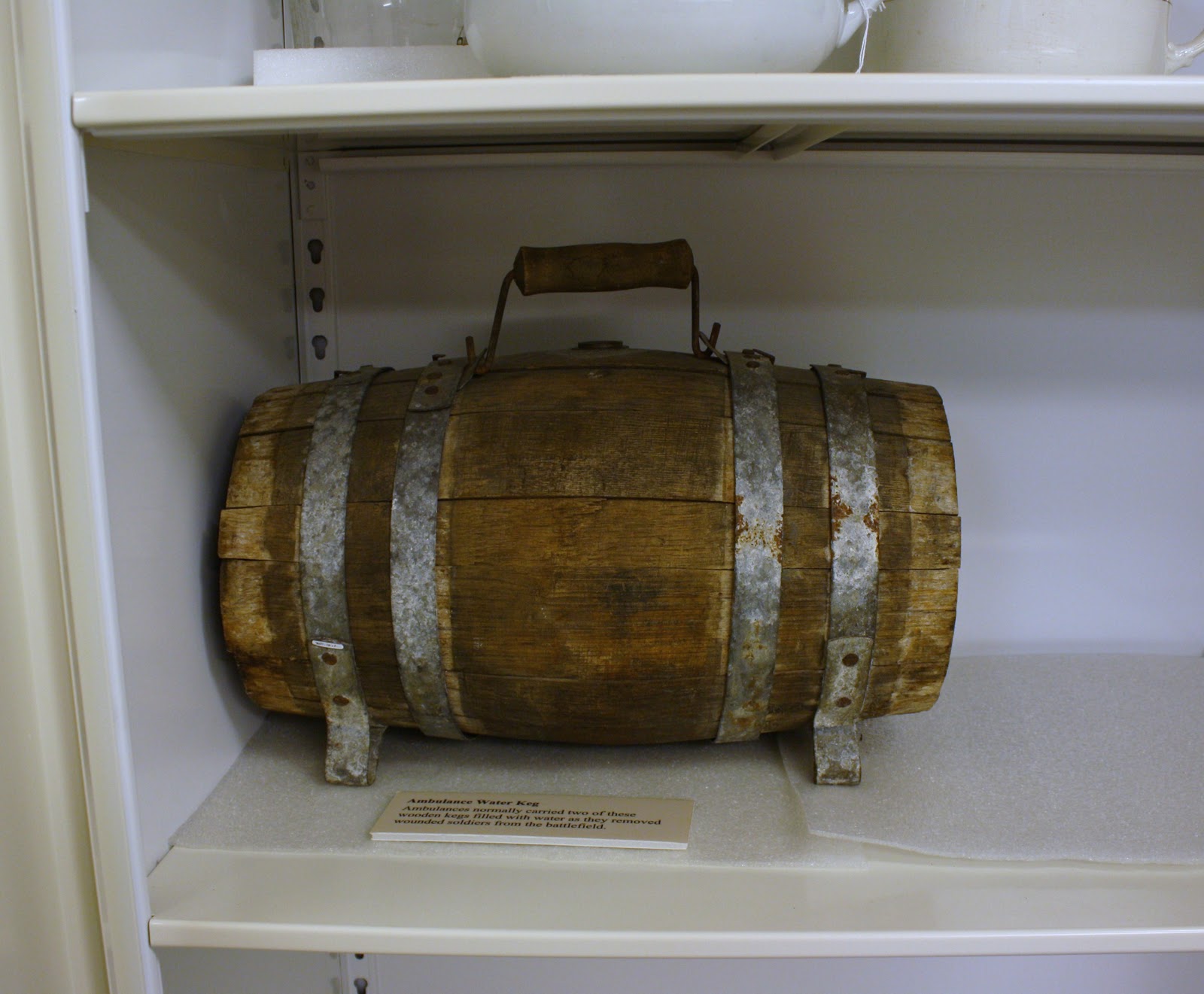
This is an ambulance water keg.  Civil War ambulance wagons would have
been outfitted with two of these when they were sent out onto the battlefields.


Books are also stored on shelves in these cabinets. 
These books have each been fitted with acid-free cardboard
covers for further protection against light, dust, and abrasion.


Documents up to legal-size are kept in the same kind of cabinets. 
They are housed in archival folders inside these document boxes.


Small and medium-sized items are kept in cabinet drawers. 
Here you see a collection of medicine bottles which were part of a Confederate
drug kit.  Notice that each bottle has its own padded compartment in the drawer,
which prevents damage to them when the drawer is opened and closed.


Large items can be stored on open shelves. 
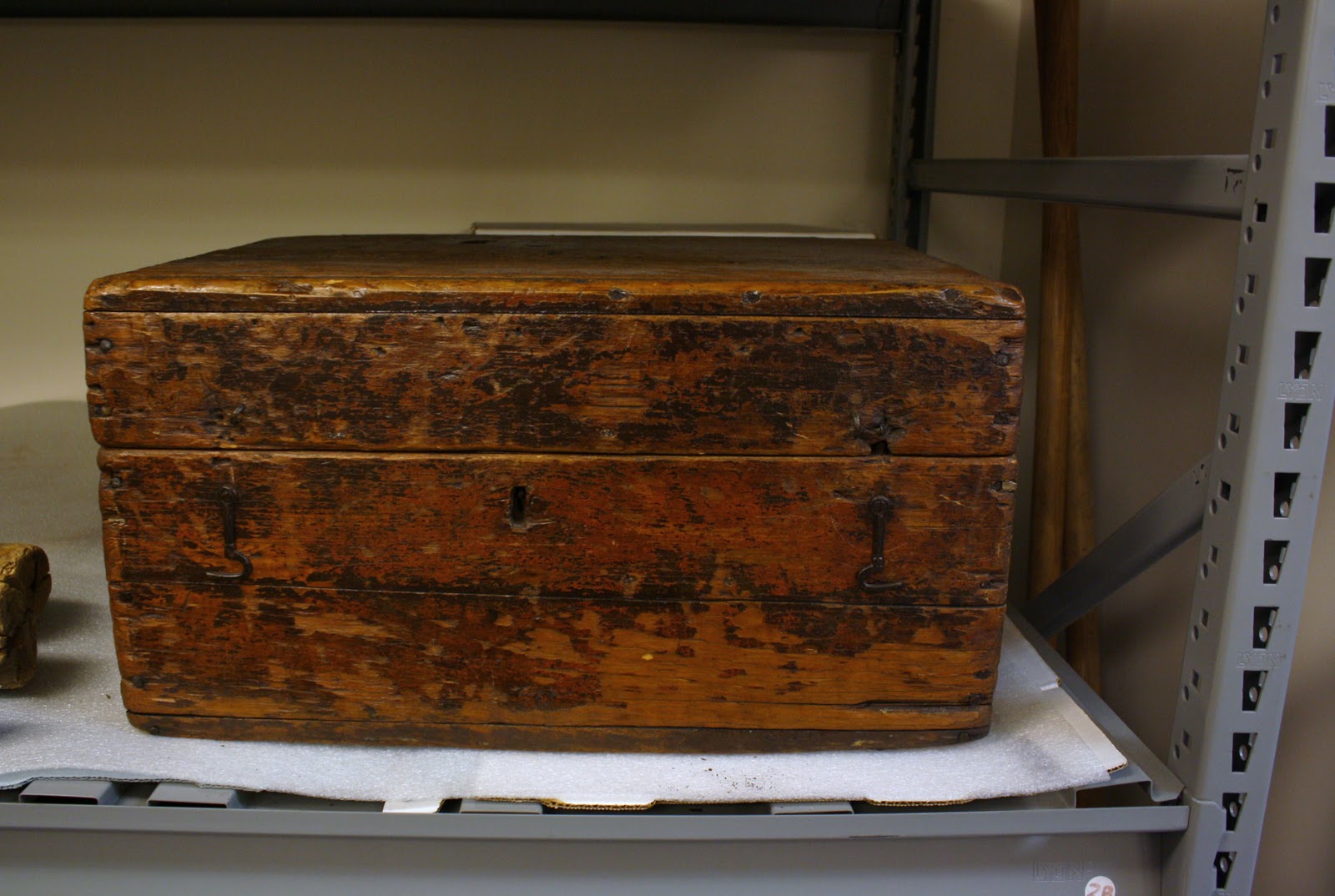
This is a wooden medical chest which contained drugs and
hospital supplies and was used by the U.S. Hospital Department
during the Civil War. 


Very large items, like this Civil War dentist’s chair, must simply be stored
on the floor of the collection room.  
This dentist’s chair has an adjustable headrest and seat, and it reclines.  The
octagonal wooden tray on the left arm held the dental instruments, and it can
be swiveled to various positions.  The metal ring attached to the right arm
would have held a spittoon.  Even then, dental patients had to rinse and spit!

     I hope you enjoyed your photo tour of the collection room.  If you’re like me, you’ve spotted quite a few interesting artifacts along the way.  That’s the best part of touring any collection room!  We’ll have to come back another time for a closer look at some of them.  


Photos courtesy of the National Museum of Civil War Medicine.   

Thursday, October 27, 2011

Creepy Crawlies

     Since it’s almost Halloween I thought I’d do a post about a more “creepy” subject, insects.
     One of the less exciting aspects of my job is monitoring for insects in order to detect and prevent insect infestations.  Monitoring is done by placing sticky traps in various locations and recording the number and kinds of insects which are found on them.  

  
This is a hospital exhibit at the NMCWM.  Displayed in the back
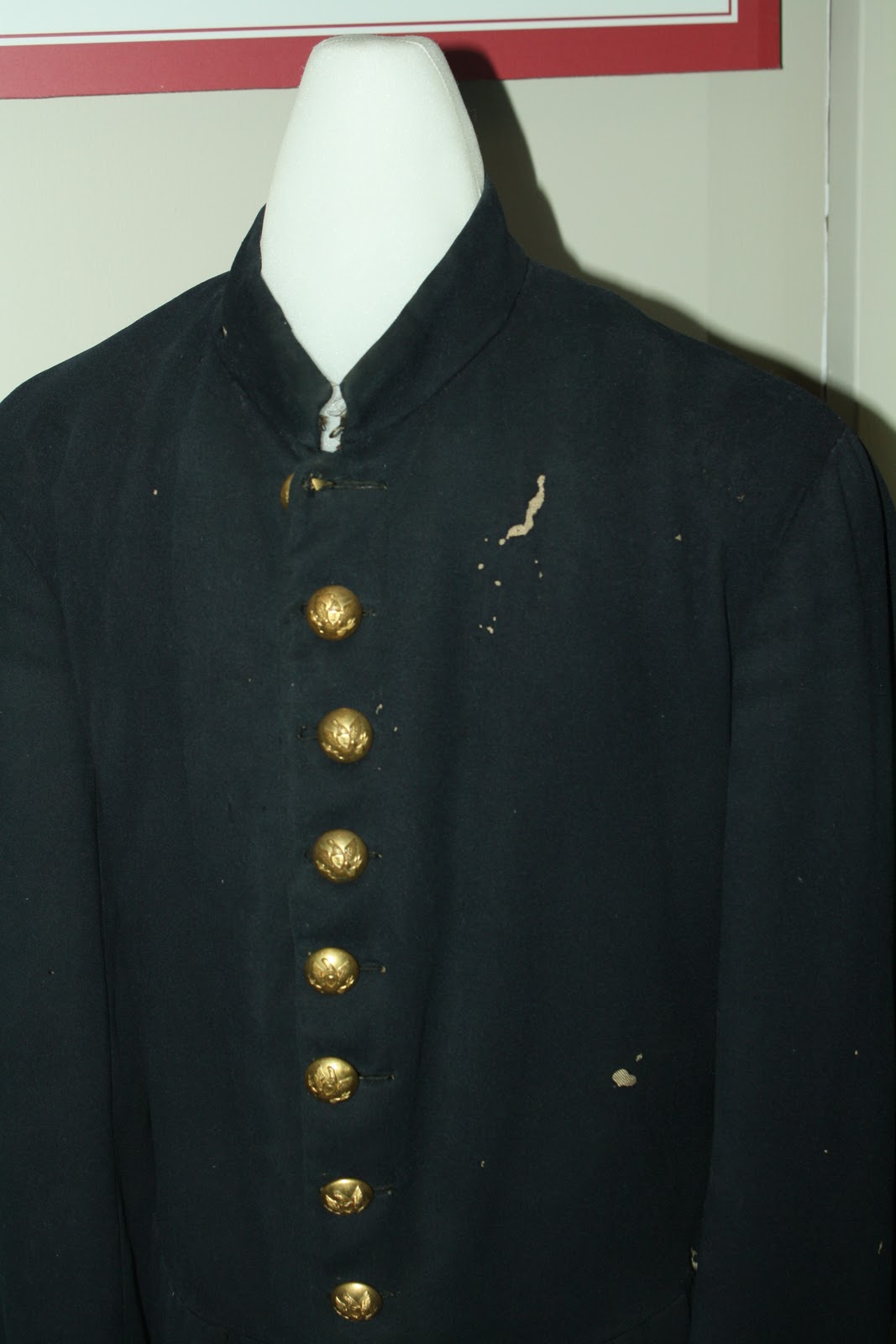
 is a hospital flag.  On the left is a hospital gown and on the right is a hospital
steward's frock coat.  But, can you spot the insect monitor in the exhibit? 


It's probably easier to see it in this view.  The insect monitor (sticky trap)
 is in an inconspicuous spot on the floor.  You may also notice another type of monitor
on the side wall.  That one keeps track of the temperature and relative humidity in the
 exhibit case.  That's a topic for another post though!

  
     My very first duty here at the museum was dealing with a moth infestation.  My first view of my new office included several moths clinging to the ceiling and the trim of the door.  This is NOT a sight that any collection manager wants to see, much less their first day on the job!  I immediately called the exterminator and put out some moth pheromone traps.  I didn’t shun the low-tech options either.  My new coworkers got used to seeing me patrolling the floor armed with a flyswatter!  Eventually the little winged pests were  eradicated, and everyone was relieved.


The culprit in this instance was Tineola bisselliella, the common clothes moth.


     It turned out that the moths (eggs) had been brought in on a donated item of wool clothing, which was in the quarantine cabinet in my new office.  Once the offending item was discovered it was immediately removed and treated.  Luckily, there were no other cloth items in the quarantine cabinet at the time, but as a precaution the remaining items spent additional time in quarantine being monitored.  It was a good reminder of the importance of the quarantine process.  Though we did have to deal with a moth infestation in our office area, none of the moths got into the collection room or the galleries.  They could have done quite a bit of damage there!           


Here you can see what is probably moth damage on a wool Union Surgeon's frock coat.  I should point out that the coat came to us in this condition!


     I am happy to report that insect infestations are a rare occurrence here.  I’ll certainly do all I can to keep it that way!
    
Here's my creepy photo.  This is a close-up of an insect monitor from our office hallway, with a large cockroach on it.  Normally I can keep these traps out for a few months, but for some reason my coworkers asked that I get this one out of their sight! 

     Happy Halloween everyone, and may your day be free from insect pests!

Artifact photos courtesy of the National Museum of Civil War Medicine.

Thursday, October 20, 2011

Taking your artifact for a walk?

     Most of the artifacts we acquire are donations.  Occasionally we find the reason, and more importantly the funds, to purchase an artifact.  One purchase a couple of years ago was rather unique.  Our Director was walking back to work from lunch when the owner of an antique shop happened to be putting an antique wheelchair out on display in front of the store.  It was a slightly post-war chair, but we do have plans for an exhibit on Civil War veterans.  At the end of the Civil War there were thousands of veterans recovering from illnesses and wounds.  Some of them recovered in hospitals and would have required the use of a wheelchair.  This wheelchair could certainly have been used for this purpose.  So, I was quickly summoned to pick up our latest acquisition.
A circa 1870 Eastlake style caned wheelchair with metal-rimmed wheels and upholstered arms and foot rest. 

     Normally moving a large artifact involves an art handling company, or at the very least a museum staff member’s vehicle and lots of padding materials.  Since the shop was only half a block from the museum and the chair was in good working order, we decided just to wheel it (carefully!) down the sidewalk.  At this point I should mention that the Director had broken his foot and was in a walking cast.  We obviously made a strange sight pushing an antique wheelchair down a busy sidewalk.  More than one passerby commented that my limping boss should be riding in the wheelchair!  We also got a lot of questions about the chair.  People wanted to know where we were taking it, how old it was, and of course if I would let them ride in it.  I politely told them ‘no!’  It certainly created a lot of interest in the museum though, and we joked later that we should take our artifacts out on walks more often!

Detail of the design on the back - a typical Eastlake style.
     The wheelchair’s next “home” was my office, at least for the next month.  Every new artifact which comes into the building has to go through a period of quarantine before it can be put into the collection room with the other artifacts.  During that time it is inspected regularly for any signs of mold, mildew, or insect infestation.  I thought once I got the wheelchair back to the museum it would be safe from people at least, but I was wrong.  I had to yell at two different people not to sit in it before I finally tied a piece of ribbon between the arms to keep people out of it.  You’d think they would know better….


A worn spot in the fabric on one arm reveals the horsehair stuffing.  The upholstry on the chair was my main worry as it would be a prime spot for insects to hide.


     But now the wheelchair is stored in the collection room, waiting its turn to go on exhibit.  At least it is safe from people sitting in it!      

Photos courtesy of the National Museum of Civil War Medicine.

Friday, October 14, 2011

Getting Started


     Welcome to my blog!  If you’ve ever wondered what it’s like to take care of a collection of artifacts at a museum, you’ve come to the right place.  Whenever I tell people what I do, they tend to comment that I must have a very interesting job.  So, here’s where I plan to share what I hope will be an interesting, educational, and even entertaining account of doing my job.
     The hardest part of starting a blog is coming up with a name.  I am a Collection Manager, more specifically I am the Collection and Exhibit Manager at the National Museum of Civil War Medicine.  I wanted a name that conveyed what I do.  Though I wear a lot of “hats” in my job, they really all have the same basic purpose – to protect and preserve the artifacts in the museum’s collection.  In fact, when I was hired I recall the Director of our museum telling me he wanted someone who would act as a bulldog to protect the collection.  I wasn’t thrilled about being seen as a bulldog though, so I decided on Guardian! 
     A recent museum acquisition arrived in the mail a few days ago.  We tend to get some rather unique things here.  In this case, it was a brass suppository mold.  And yes, I was excited to receive it!  We actually have one in the collection already, which I enjoy showing to visitors.  When I ask them what they think it is they invariably reply that it’s a bullet mold.  Then I remind them that we are in a medical museum! 

                                        A 19th century 12-chamber brass suppository mold


     It seems this mold had also suffered a case of mistaken identity.  The donor told me that when he’d purchased it, it was in a box of items which also contained bullets.  He’d assumed it was a bullet mold.  It wasn’t until he visited the museum a few years later that he learned what it really was! 
     Once the mold arrived here, I discovered why it may have been in that box of bullets.  I wasn’t surprised to find some dents and scratches in the brass, or that the closing mechanism wasn’t original, or that there were traces of wax on the surface.  I was surprised though to discover that one of the chambers was slightly different from the others.  The base had been bored out slightly larger, and the blunt tip had been modified to a pointed one.  It appears that someone tried to convert it into a bullet mold, unsuccessfully I’m sure considering that the other 11 chambers hadn’t been modified. 

      Notice the differences in the chamber on the far left. Also note the spot of green wax in the fourth chamber.                   
    

     I heard one person comment that it was too bad people would ruin artifacts like that.  I did see his point, but I was also a little taken back.  Granted, this artifact’s monetary value isn’t as great as one in its original form, but this one has a “story” to tell; it has a unique history that is revealed in its imperfections.  That makes it valuable in a different way.  And my job is to preserve it and its story.

Photos courtesy of the National Museum of Civil War Medicine