Thursday, December 6, 2012

Abraham Lincoln


     On Monday, the staff of the NMCWM was fortunate to be allowed the afternoon off to view the movie Lincoln.  It was a field trip of sorts! 
 
Here is the staff in front of the theater. A big thank you goes out to George, Tom, and Katie for staying behind to keep the museum open while the rest of us saw the movie!
 

     I’d heard a lot of good reviews about the movie, so I was eager to finally see it.  Though I thought there were a couple of instances that showed a definite Hollywood interpretation, I did enjoy it overall.  There were even some short scenes that touched on Civil War medicine, which justified our trip!  I think my biggest disappointment was the fact that the severed leg of General Sickles in its display case was shown briefly in one scene, but was not identified.  What a great opportunity they missed in not mentioning that story!

     Since there is so much interest in Abraham Lincoln at the moment, I thought I’d share a few of the Lincoln artifacts in the museum’s collection that are not currently on display.


Here is a Certificate of Commission for Dr. Elias J. Marsh, which bears the signature of President Abraham Lincoln, and is dated August 10, 1861.


     A letter in our collection that was written by Civil War nurse, Clarissa Jones, on April 15th, 1865 about Lincoln’s assassination reads:  “I am unfit to write or even think.  I am utterly prostrated in mind by the awful news of last evening—I am just starting out to try to get a paper to send to you with this, fearing I may not succeed I will mention the terrible calamity of which the paper gives a better def.

     The Pres. was last night shot while in the Theatre and died this A.M. at 7.  Sec. Seward was stabbed while in bed, and his son mortally stabbed by the same man—he has since died—reports to the effect that Grant also was assassinated….but it has not been confirmed—“  It shows the shock and grief many people felt at the news of his assassination, as well as some of the rumors which circulated.
 
 
One of our more interesting Lincoln items is a replica of a plaster life mask made by Leonard Volk in 1860.
 

     A life mask is made by applying plaster to a person’s face and letting it dry.  Petroleum jelly or oil is put on the subject’s face first, but there can still be some hair pulled out when the mask is removed.  Mr. Lincoln is said to have commented that the process of removing the hardened plaster cast from his face was, “anything but agreeable!”  He was reportedly pleased with the final product though.  He had another life mask done about five years later, and it is interesting to compare the two masks.  The presidency and the war appear to have aged him much more than five years.  You can see a short video about the two life masks here. 
 
 
Here is a cast of Lincoln’s hand which was done at the same time. The object he is clutching is a broom handle, and the hand next to the cast gives some perspective for the size of his hands!
 

     Though these casts are interesting to study, I think I’d prefer to simply have a picture taken!

  
Photos courtesy of the National Museum of Civil War Medicine.

Thursday, November 29, 2012

Sewing on a 150-year-old Button


     I’ve mentioned before that displaying artifacts is a sort of balancing act.  I have to weigh the requirements for preserving and protecting the artifact with the need to have it on display.  Though the artifacts would last longer if kept in storage, they wouldn’t be available for people to see, appreciate, or study.  So, when artifacts are stable enough to display, I try to ensure that they are displayed in a manner that does the least amount of damage.  However, on occasion I do have to deal with damage to an artifact.

     Last week I was changing one of those pesky burned-out light bulbs in an exhibit case.  While I was in the case, I took the opportunity to inspect the two garments that were on display there.  Insects, especially moths, are a constant concern wherever there are textiles on display.  They often start “munching” from the inside of a garment, where they are not readily visible.  Fortunately, I didn’t discover evidence of any sort of insect infestation.
 
Here you can see the quilted green silk lining (which may have originally been black) of a wool Union Hospital Steward’s coat, with black velvet lining at the collar, and hand-stitched buttonholes. This was a very nice coat for its time!
 

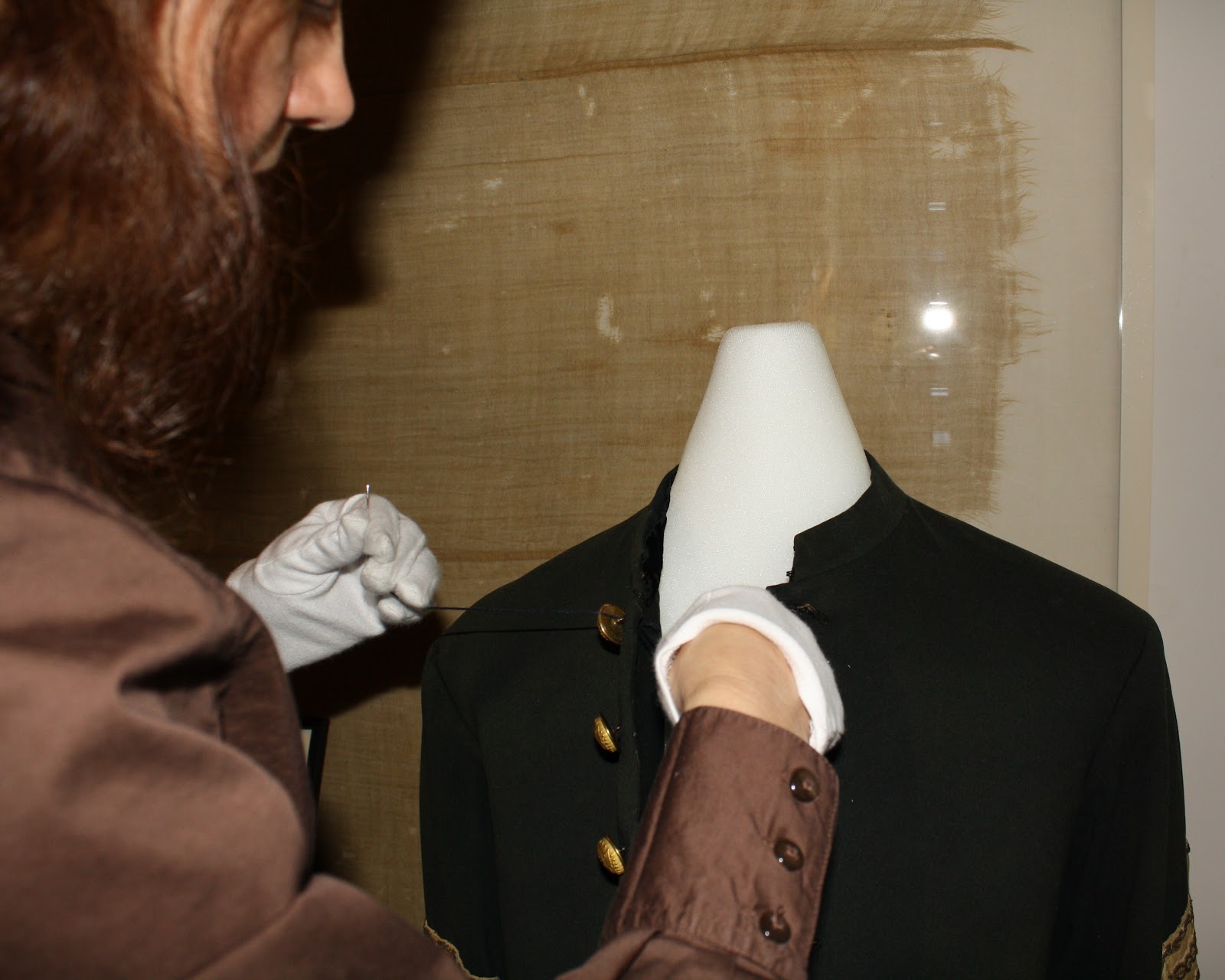
     However, I had to very carefully unbutton the coat to inspect the lining, and in the process the top button popped off.  I was not a happy curator at that moment! 
 
Here is the front of the coat, showing the missing the top button.
 

The button itself was not damaged; it was the dry-rotted thread that broke. While the button was free, I took a moment to document the markings on the back. As you can see, this button was made in New York by the company Schuyler, Hartley, and Graham.
 
     My next step was to report the incident to the museum’s Director, and to document it for the museum’s records.  I noted the missing button and the date on my artifact data base, and took photos of the coat and the button.  This artifact is owned by the museum, but if it had been an item on loan to us I would have also reported to the owner.  After that, I was ready to plan for making the repair.  I had sewing needles and cotton thread in my supplies for occasions like this.  I opened the case again to get to the jacket one morning before the museum was open so that I didn’t have to worry about visitors coming through while I was working! 
 
Here I am sewing on the button. Though normally this is a fairly simple task, the gloves made it a little more challenging! For a different kind of button or for a simple repair just to the fabric I may have chosen not to wear the gloves. It is better to handle metal items, like this brass button, with gloves.
 

     While examining the coat, I had also noticed some puckering of the fabric along the front – you may be able to see this in one of the previous photos.  This coat has a somewhat rounded front, which is typical of other men’s coats of the period.  The form for the coat was not offering enough support to the fabric at the chest.  Since the coat was already unbuttoned, it was a good time to add a little extra padding underneath.
 
 I just added some layers of cotton batting to the front of the form, so that the coat wouldn’t pucker. I was careful not to add enough to put stress on the buttons and buttonholes though.
    

And here’s the coat, now with a little extra padding and with its button back in place! 
 

     Though I would have preferred the button to have remained attached, I am glad that it was a simple repair, and that many more visitors will be able to see and enjoy this beautiful coat.


Photos courtesy of the National Museum of Civil War Medicine.

Thursday, November 15, 2012

Embalming in the Civil War


     Last month it was time to change the display again in the Command Building at Ft. Detrick.  I received the request to feature a product or process that changed or developed during the Civil War.  I had a few options, but since the display was going to be installed just before Halloween, it seemed appropriate to highlight embalming!

     Although the practice of embalming dates back to ancient Egypt, the procedure was not widely practiced in the United States until the Civil War.  Since so many soldiers died far from their homes and their families usually wanted them buried at home, there was a need to preserve their bodies for the journey. 

     Another factor in making embalming known to the general public was the death of Colonel Elmer E. Ellsworth.  Col. Ellsworth was a friend of President Lincoln, and was also the first officer to be a military casualty of the Civil War.  On May 24, 1861, he was shot while removing a Confederate flag from the roof of a hotel in Virginia.  Dr. Thomas Holmes, who is known as the father of modern embalming and who had recently opened an embalming office in Washington D.C., offered his services for free.  No doubt he saw an opportunity to acquaint the public with his craft!  Col. Ellsworth’s body was embalmed and displayed to the public at his funeral, and people were impressed with his “lifelike” look.  After the President’s assassination, Mrs. Lincoln even requested the same procedure for him.
 
 
A Harper’s Weekly newspaper from June 15, 1861 depicts the killing of Colonel Ellsworth.


     Embalmers of the time used a variety of different solutions for embalming.  It was common to find various combinations of arsenic, creosote, mercury, turpentine, and alcohol in these solutions.  Though effective for embalming, these solutions could be hazardous to the embalmers.  They can also still be hazardous to the curators and collection managers who handle some of the embalming artifacts!
 
 
This is an embalming kit which contains an embalming pump and the assorted needles, connectors, valves, and handles which were used with it. Embalming was performed by pumping embalming fluid into an artery, usually in the area of the thigh or armpit.


The doctors in this photo are demonstrating embalming to two Union officers, with what appears to be some of their work displayed on either side. There is some question whether those are really soldiers posing as embalmed bodies for the photo though! The setup pictured was probably typical of that found near a battlefield or field hospital.


And here is Dr. Richard Burr, an embalming surgeon who worked here in Frederick, shown embalming a soldier recovered from the battlefield. You can see the embalming pump in his right hand, and the tubing attached to it above the chest of the soldier’s body. Embalming tables were not usually available in the field, so here he is using a door placed over two large barrels.
 

     As the Civil War progressed, the demand for embalming services increased, and more people saw the opportunity to make some money by becoming embalmers.  Embalming fees varied and usually were based on the soldier’s rank, or the supposed ability of his family to pay.  Some embalmers would hang around the camps and promote their services – which was not great for morale!  Others would search the battlefields for the highest ranking dead officers, hoping to make money by contacting their family and offering their services.  Some sources claim that our Dr. Burr was not the most honest embalmer.  He seems to be fairly well known for price gouging as well as for reselling the same grave markers for locally buried soldiers.  There are even some stories which claim he robbed dead and dying soldiers as he searched the battlefields.  He was not the only one, by any means.  It was enough of a problem that in March 1865 the War Department issued General Order Number 39, "Order Concerning Embalmers."  This order required, “…all who embalm or remove bodies of deceased officers or soldiers to obtain a special license...”  It also set the prices which embalmers could charge.  Unfortunately, this order came late enough in the war that it had very little effect.
 
 
A closer look at General Orders No. 39, the Order Concerning Embalmers.
 

Here is the embalming display at Ft. Detrick, before the lid was put on. On display are a photo of Colonel Ellsworth, an embalming pump and attachments, the two embalming photos which I’ve included here in my post, an advertisement for an embalmer, and General Orders No. 39. If you have the occasion to be in the Command Building, please stop by and take a look!


Artifact photos courtesy of the National Museum of Civil War Medicine.

Thursday, November 8, 2012

Veterans, Zouaves, and Dolls


     Since Veterans Day is approaching, this week seems appropriate for writing about another one of my favorite artifacts – a clothespin penny doll from the Civil War.  At first you might wonder what a small doll has to do with Civil War medicine or with veterans.  These clothespin dolls were often made by Civil War veterans, sometimes while the veterans were recuperating in the hospital.  The dolls were a source of income for them and, as the name implies, usually sold for a penny.  Many times the doll clothes were made from the veteran’s own uniform or a flag – which can give some hints as to the maker of the doll!
 
 
Here is the clothespin doll, dressed in a Zouave uniform. The shirt that appears tan in the photo was probably originally white. The red, white, and blue coloring of the clothes suggests that they may have been cut from an old flag. Also notice that one of the doll’s legs is shorter than the other. This may indicate that the doll’s maker was an amputee, and that he made the doll to resemble himself.


     Both the Union and Confederate sides had Zouave regiments, so this doll could have been made by a veteran from either side.  The Zouaves’ colorful uniforms, which were based on those of the French Army, varied somewhat from unit to unit.  They usually consisted of a short, open jacket, baggy trousers, and a wide sash.  The headgear was often a fez with a colored tassel.  Though rather exotic in appearance, this uniform allowed the wearer a greater freedom of movement than with a standard uniform, and was better suited for warm weather. 
 
 
This is an image of an unidentified Union soldier in Zouave uniform, courtesy of the Library of Congress. Notice the similarities to the clothespin doll!


Here’s a closer look at the doll’s painted face. The black hair is still clear, but the facial features have faded. You can still make out parts of the eyes and the tip of the nose though. You can also see that the fabric is starting to deteriorate. This is why the doll is kept inside a box – the less it is handled, the less stress is put on the already fragile fabric. 
    
 
     If you'd like an even closer look at this doll, it is currently on display at The Lyceum: Alexandria's History Museum, in Alexandria, Virginia.  I’m sure this doll’s maker had no idea his little creation would still be fascinating people over a hundred years later!

 
Photos courtesy of the National Museum of Civil War Medicine, except where otherwise noted.

Thursday, November 1, 2012

Weathering a Hurricane


     I know that last week I promised you a post about Civil War embalmer Dr. Richard Burr, but it seems more appropriate to cover Hurricane Sandy this week!  I’ll get back to Dr. Burr in a couple of weeks.  I will also apologize for only having one photo this week, but I have been stuck at my home for the past couple of days.
 
 
Here is the reason I couldn’t get to the museum after the hurricane – a large tree came down across my driveway and brought a power line down with it. The tree can’t be moved until the power company can come out to secure the live wire, and they have a lot of other problems to deal with at the moment!
 

     The hurricane preparations started about a week ago when the weather reports indicated that it might affect our area.  At that point, the staff was alerted to keep an eye on the weather reports.  The museum’s staff contact information was checked to be sure it was current and was then distributed to all employees so that we could communicate with each other outside of the museum if necessary.  Each employee was instructed to double check that their work flashlight had working batteries, and we checked the status of our emergency kits as well.  Our Director, George, advised us to have the proper emergency supplies in our homes as well.

     When it became clear that Hurricane Sandy was heading our way, closing procedures were discussed and duties were assigned.  My job was to ready the galleries in the main museum for the storm and to check on them as long as weather conditions allowed.  The Pry House was assigned to Tom.  The rain started on Sunday night, and we got the official word that the museum would be closed to the public the next day.  On Monday morning the rain was somewhat heavy, but there was not much wind yet, so I went in to check the museum.  I double checked the doors and windows and brought in the flags.  I also put plastic over the two areas that sometimes leak during very heavy rains, and, with George’s help, moved the display panels away from those areas.  I walked through the galleries a couple of times that morning to check for leaks, but all was well at that point.  The radar was showing that more severe rain and wind were heading our way, so I went back home and George took over at the museum.

     My plan was to go back and check the museum again in the morning (unless called in sooner), but the tree in my driveway prevented that!  I did stay in touch with George and learned that there was only one very small leak in the galleries, which was not near any exhibits or artifacts, but was not in either of the usual areas.  He set up a fan to dry the carpet.  The worst damage was to the museum’s front door, which was ripped off its hinges by the wind.  Fortunately, we do have a second set of locking entrance doors, so the contents of the museum were not in danger.  The museum stayed closed for a second day though, while the front door was repaired.

     The museum is open now.  Overall, it seems we weathered the hurricane pretty well, with no injuries to the staff, no damage to the artifacts, and only minor damage to the museum building.  I hope everyone else was as fortunate and well prepared!

Thursday, October 25, 2012

Some Museum History and Ghost Stories

     The building which houses the National Museum of Civil War Medicine is a particularly fitting one for us.  The original building predated the Civil War.  Prior to the war it was owned by James Whitehill, a furniture maker and undertaker.  During the war he provided caskets and grave markers to the military hospitals here in Frederick.  Dr. Richard Burr, a Civil War embalmer, also worked from this location in 1862, after the battles of South Mountain and Antietam.  I will be telling more of Dr. Burr’s story in next week’s post!  

     After the war, Clarence C. Carty bought the property from Mr. Whitehill’s widow, and established his own furniture and undertaking business on the site.  He also bought the adjoining property and housed his family there while renovating the building in 1892.  The pre-Civil War building at the front of the property was replaced at that time.  However, the rear section of the building (from the 1830’s) remained.  This is probably where the embalming was performed in the fall of 1862.  The Carty family continued to run their business here until 1978.


This photo of what is now known as the "Carty building" was taken around 1884 and shows Willie Keller, handyman; Henry E. Carty, who later ran the business; and Clarence C. Carty, who started the business. And yes, that is a rocking chair on display up on top of the sign post! This image, which is on display at the NMCWM, is courtesy of Frances Randall.


Here is a more recent photo of the Carty building, which has been home to the National Museum of Civil War Medicine since 1994. The building next-door, which also belonged to Mr. Carty, is now a separate property. You can still see many similarities to the building in the older photo though – especially the front doors and large display windows.


     Though there was an extensive remodeling project on the interior of the building in 2000, one part of the historic building still remains.  A freight elevator, used for the furniture which was manufactured here, is preserved in a corner of the museum’s collection room.


This freight elevator, believed to be the oldest one in Maryland, was probably installed in 1892 when Clarence Carty did his renovations.
 

This metal plate on the elevator shows that it was manufactured by James Bates of Baltimore, Maryland, and that this design was first patented in 1871. James Bates is credited as inventing the first automatic elevator in 1856. 


     Since it is an old, historic building, and it was once an embalming station, it is not surprising that there are also quite a few ghost stories associated with it!  I tend to be a skeptic about the subject though, and some of the stories can be debunked pretty easily.  My favorite story involves a “ghost hunter” who was going through the galleries with a device which was supposed to read the electromagnetic fields produced by the ghosts.  He was very excited to see high readings near many of the exhibit cases he scanned.  He reported that it appeared that most of our artifacts on display had spirits associated with him.  He was rather disappointed though, when it was pointed out to him that the readings were being caused by the magnetic locks on our exhibit cases!


And then there’s this photo of dozens of ghostly orbs in our Camp Life display, taken when the exhibit was being installed. Some people say the orbs are spirits, but a quick Google search of “orbs in photos” reveals that they are more probably caused by dust.


     However, I will admit that not all of the stories can be so easily explained.  There are enough consistencies in different people’s accounts of these stories to make me wonder.  The most reported occurrence is hearing footsteps on the ramps between the galleries.  This is one which I have experienced.  It is a very strange feeling to hear what seem to be footsteps following you, when you are alone!  Once I even ran back down the ramp toward the sound, because I was sure that one of my coworkers was hiding around the corner and trying to scare me, but there was no one there.


Here is our Deputy Director, Karen, standing in front of the building’s old doorbell. Although now the only way to operate this doorbell is to be standing in front of it and physically move the bell strikers, she sometimes hears it ring when she is the only one on that floor.
Also, notice the Carty building artifacts on the left side of the photo – one of the original Carty signs and a framed death certificate for Clarence Carty.


     Other stories we hear often from staff and visitors involve seeing images of people in Civil War era clothing, or feeling like someone has brushed against them when there is no one close to them.  On the third floor of the museum, more than one staff member has reported seeing a woman in a gray dress, or hearing children running and playing in the hallways.  Other people report that books sometimes “fly” off the shelves, or that paper clips jump out of their containers.

     Our Executive Director, George, talks about some of the things that have happened in the museum in the link here .

 
     Whether or not you are a believer, they certainly make interesting stories to tell, and they make you wonder about the previous occupants of the building.


Photos courtesy of the National Museum of Civil War Medicine.


Thursday, October 18, 2012

A Look at Lee's Lost Order

     Do you find that you tend to visit museums that are outside your local area, but you put off visiting the local ones?  I know that I’m sometimes guilty of thinking that I will get around to visiting the local ones someday.  However, when I heard that the Monocacy National Battlefield was exhibiting Special Orders 191 (also known as the Lost Order), I decided it was time for a visit!
 
 
The Monocacy National Battlefield is less than five miles from the National Museum of Civil War Medicine, so I didn’t have to travel very far! The Visitor’s Center is the starting point for a self-guided auto tour of the battlefield and it also houses displays of artifacts associated with the Battle of Monocacy. This is where the Lost Order will be on display until October 31 of this year.


It was raining the day I visited, so I didn’t linger outside. I did manage to take a moment to photograph the cannon on my way though.


     The Monocacy Battlefield is the site of the Civil War battle fought on July 9, 1864.  Though not as well-known as the Battles of Antietam or Gettysburg, it is credited as being the battle that saved Washington D.C.
 
 
The burning of the covered bridge depicted in this painting prevented the Southern troops from easily crossing the Monocacy River on their march to Washington. Delaying them allowed General Grant time to send more troops to defend Washington.


As always, I am on the lookout for display ideas. Here, children can try on various uniform parts.


There is an observation deck at one end of the building with a wonderful view of the battlefield (especially now when the leaves are changing color), and panels which identify the points of interest.


     The Lost Order is in the final display, and though I was eager to finally see it, I was disappointed that photographing it was not allowed, even without a flash.  It was a little ironic since I’m usually the one telling people they can’t photograph light-sensitive artifacts!

     Special Orders No. 191, later known as the Lost Order, was issued by General Robert E. Lee on September 9, 1862 during the Maryland Campaign while his army was camped on a part of what would later be the Monocacy Battlefield. The orders outlined plans for dividing his army into four parts.  Copies of the orders were written for each of Lee's commanders.  However, the copy written for Major General Daniel Hill was somehow lost. 

     On September 13th, soldiers from the 27th Indiana Volunteer Infantry discovered the orders on the ground, wrapped around some cigars.  Though at first they were more interested in the cigars, once they read the paper’s title, "Hdqrs. Army of Northern Virginia", they quickly passed it up the chain of command.  When the order reached General McClellan, he reportedly exclaimed, "Now I know what to do! Here is a paper that if I cannot whip Bobby Lee, I will be willing to go home!"  Lee’s invasion plan failed, and the stage was set for the Battle of Antietam.


Corporal Barton W. Mitchell is credited with finding the orders. Copies of some of his letters are on display along with the Lost Order, courtesy of the Mitchell family. Photography of these documents is allowed!


Luckily, there are images of the Lost Order available online. This one is courtesy of the Library of Congress. It’s hard to believe this small piece of paper had so much influence on the Civil War!


     You can read more about the Lost Order
here.  

     So, I hope the lesson learned here (beyond keeping track of any orders you are transporting!) is to visit your local museums; you never know what kinds of treasures you will find there!